Showing posts with label Burning Wheel. Show all posts

Friday, May 1, 2015

Spyder's Burner: Character Burning


Character burning for Burning Wheel is a very involved process. It's exhausting and takes a toll on the players, much like session game-play of Burning Wheel. After being in five games (ran four played in one) I found a weird trend: that first, exhausting session of gameplay was never really referenced for the rest of the game. And each time it's felt like such a waste, cause so much time was spent on making the character, so much effort went in to making this character's history, and how much do the players have to show for it?

Well, in my games? Nothing.

As I pondered the problem I looked at the way my group did character burning. We just put the lifepaths together after some talk about the characters and the situation, and that was it. It was a solely mechanical affair and I sure as hell never took notes. No wonder none of it mattered, we hadn't made it matter! A game about character progression and we never bothered to track their pasts, even a little bit. Now Burning Wheel says to not detail out the backstory too much, so I'm not talking about all of it, but the broad strokes can't hurt.

And then I thought about it another way. Alot of long novels, like the Count of Monte Cristo, Game of Thrones, and The Brothers Karamazov start with a short biography on what the character's been up to right until this point in the novel, explaining the psychology of the character so everyone knows what they're getting themselves into as they start the story. And that's exactly what the first session could be: the explanation of where everyone's been up to this point.

So here's what I want to do the next time we burn up characters:

  1. Ask questions! "Who was the knight who you were a squire for?" "How did you wind up becoming an assistant for the court?"
  2. WRITE THE ANSWERS DOWN, both of you! There's a notes section in the character portfolio, make ample use of it. Note important persons from the past, why you stopped being the town baker and joined the army, things of that nature. Don't make answers, make questions that can be resolved later. 
  3. Ask how big of an impact the character's decisions have had on those around him. Mandate reputations and affiliations to match.
  4. Ask even more questions. Consider different angles on the characters' actions. Could they be the villain in someone else's story already? A hero? Write down more.
The focus would be to develop a persona with the player, a person who lives, breathes, and has bled. The mechanics should back up the story and the story should generate mechanics. Here's hoping that during the next campaign I can fix the problem. The first session is the beginning of the characters' story. Everyone should know what's going on.

Sunday, March 22, 2015

Spyder's Burner: Character Traits


Traits: they're the least talked about part of Burning Wheel. Don't pretend that you don't know what I"m talking about. Go peruse the Burning Wheel forums. It's Beliefs this, Instincts that, how am I supposed to write this Belief, is this Instinct going to get me into enough trouble? Well, I'm here to say that I think that's a load of bunk. Traits are where it's at. Traits define the character in ways that Beliefs and Instincts never can, because they define the most important part of the character: the lessons they've already learned.  I'm first going to lay out the basics of the Burning Wheel Artha Wheel, explain how Character Traits help this Artha Wheel to turn, and then go into using Traits to help generate Beliefs and Instincts, and finally give some tips on how to make Character Traits more meaningful in Character Burning.

Burning Wheel is built for the zero-to-hero story: you start out as a broken and flawed individual who has potential and, over the long 30+ sessions, become a hero. The Beliefs are what the character is trying to do, the Instincts are little things that actually tell you who the character is, and Character Traits tell you what lessons he's already accumulated. As time goes on Trait Votes happen and Beliefs that have been resolved become Traits (usually Character Traits, but not always), because you're no longer fighting for them. They've just become a part of you now.  As you fight for what you believe, gaining Fate and Persona points, you eventually realize that your own petty little thoughts really don't matter in the grand scheme of things, so you sacrifice them so that way the grander picture can actually benefit. BOOM! There's a Deeds point. Your Beliefs change to reflect what you've just done, and the cycle kicks in again.

In this virtuous cycle Character Traits play a vital role. You get rewarded for any of your Character Traits causing you trouble or changing the direction of the story in an unseen way. Your grand schemes, summarized in the Beliefs, are going to start running up against your Traits, which summarize your past. The present and past rub against each other and create friction, requiring the player to make a stand. Notice I said the player, not the character. 

For instance, let's say you have a Belief about saving your kingdom from civil war and strife, but you have a bad relationship with your stepmom (the person currently in power) and you have the Vindictive trait. You just can't help yourself, can you? You just have to screw her over somehow. So you spit in her food as it passes by, hoping no one notices. But of course someone had to, didn't they? Now you have a real mess on your hands.

Playing the Character Traits like this allows for you to make the character more sympathetic. He's got a past and it haunts him, like it does for all of us, and sometimes that means he's going to do things you're not going to agree with. 

Character Traits can also earn you Embodiment for really good role-play.

That Vindictive traited guy we were just talking about? You think he's going to apologize for spitting in his mom's food? Heck no, he'll get up and start attacking his stepmom. Is it the smartest move? No, but since when is a guy with the Vindictive trait really out to benefit anyone? "She knew that I was the bastard and that would give her a position! She ruined my life and that's why you should trust me over her. I'd never do something like that!" Hypocritical? Oh yes, but I'll bet you those two sentences will earn an Embodiment award.

And finally there's the Moldbreaker. Playing against a Belief, Instinct, or Trait, usually requires one or the other, and Traits can be a powerful way to Moldbreaker

So someone brings that Vindictive guy aside and starts yelling at him about what he just did and how he just ruined the talks. Let's say this Vindictive guy also has a Guilt Complex Character Trait. He then drops out of the talks altogether, telling his stepmom that she's the best chance everyone has because he clearly isn't the dude to do this. That's Embodiment, Moldbreaker, and using your Character Trait to twist the story in an unexpected direction! What a session!

So what does this mean? When you make a character his Character Traits should be the big red buttons for you to press when things go wrong. When in doubt (a situation happens that doesn't hit one of your Beliefs) look at your Character Traits and act on one of them in the biggest way you can. You'll get Artha for it, almost guaranteed. If not it's because you didn't do it big enough.

Another you can do is use Traits to write your Beliefs. For instance, you have the Afraid of Wet Noises Character Trait. Weird trait, right? I mean, how the hell are you gonna use that? But, since you're always supposed to be looking for ways to make Beliefs more personal, that can come to good use!
Fearot should be killed for putting me in that well when we were kids.
Does the fact that Fearot, the horrible bandit, is destroying villages really the center of this guy's wish to take him down? No, it's because Fearot and him grew up together and Fearot tortured him. Now this character wants control of his Fear of Wet Noises by taking out the guy responsible for it. Now you have something compelling!

You can do the same thing with Instincts. Got Broken and Bitter Character Traits and you were once conscripted into the military? Take a look around and add things together of that nature
Whenever I see a soldier I hide.
That's a fantastic Instinct which won't get you in any trouble. Whatsoever. 

And last, but not least, is something I highly encourage anyone who's burning a character to do: whenever you take a trait in character burning (whether you like it or not!) come up with a small reason as to why you have it and try to associate it with a lifepath.
I'm buying Bitter and I've got that conscript lifepath. I decide to say that I'm Bitter because I was stolen from my family when they needed me most and now my parents are dead from starvation.
Don't write anything terribly long or detailed, a sentence will do. Your GM will thank you for the fodder to throw at you and you'll find that it gives deeper roleplaying.

So, in conclusion, Character Traits can be used to really powerful and subtle effect. You can use them to power your Beliefs and Instincts in ways that make it easier to roleplay the character and make character generation easier. Take a good long look at your Character Traits and play'em to the hilt!

Post-Synopsis: Andy, a good buddy of mine who was kind enough to proof read this article, pointed out that playing Burning Wheel this way will make for a very tight-knit character, the type of person who doesn't have a lot of nooks and crannies to explore, which is very true. Beliefs are far more than being rooted in the past, they're a way to explore the future of the character. At that point Traits become the texture of the character, how he reacts to things not found within those Beliefs. Which is a totally good way to do it as well. I just like having a character's future heavily influenced by his past, which feels far more realistic to me. 

Thursday, September 27, 2012

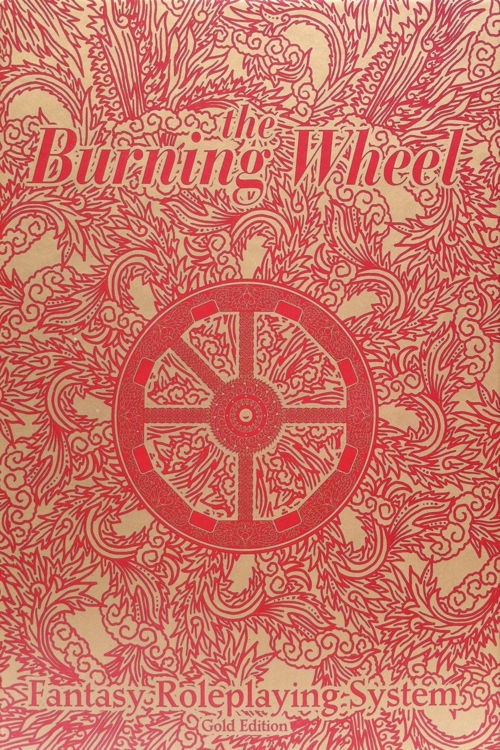
The REAL Burning Wheel Gold Review


OK, so I posted a review of Burning Wheel Gold at the beginning of the year, but it was based off of a few read-throughs and playtest reports from forums, so no personal experience to really relate to anybody. It's been 10 months and I've had quite a bit of time to run not just Burning Wheel but Mouse Guard and Burning Empires. So, here's my review, after 10 months of being soaked up in Luke Crane's work, and what do I think?

This is a truly remarkable game. There are some parts of the game that I'm not a particular fan of (character creation, you giant pain in the ass you), but the things that Burning Wheel sets out to do it does so well that I'm in awe of it. What does it set out to do? An RPG that will make stories similar to Lord of the Rings, the Earthsea Cycle, the Count of Monte Cristo. What does this mean? The RPG is designed to give you a story that will be long, character-driven, and fun, while keeping the sanctity of the character not being you, but someone who you watch develop and become attached to. This last point is probably the most important difference between this and other RPGs. We'll get back to that in a little bit. 

Burning Wheel is a D6 dice pool-based system. You roll a number of six-sided dice equal to your number in the skill, and try to roll a number of successes equal to the obstacle number, or Ob. If you succeed you get intent that you originally stated, carte blanch If you fail, however, the GM instead gets to muck with your original intent while making sure the plot still moves forward. Failed your Power check to knock that door down? Oh, you get the door down, but you attract the attention of your hated rival, who has been following you the whole damn time. Or the guards. Or your father, who owns the facility. Y'know, something awful and unforeseen but that doesn't get in the way of the narrative. These results stand for the entirety of the session, thanks to the Let It Ride rule, which states that all die rolls, unless changed, stand. So if you failed that Power check, all applicable Power checks fail until the situation changes or the end of the session. If the GM can't think of an interesting failure for your task, you automatically succeed.  Notice that interesting should mean something linked to your Beliefs, Instincts, and Traits, also known as BITs.

Oh, right, BITs. I should probably explain those. 

Beliefs, Instincts, and Traits are the things that make the wheel turn! These determine not only characterization, but where the plot will go, and what hooks the players and GM will be able to pull on to make the story move. Beliefs are an ethical statement with a specific plan of action attached to said Belief. This is where you get to state what your character is about and what he is going to do about it. Instincts are those little things your character has learned to do in the course of his life that aren't necessarily the best things to do, but he does them anyway (like "Never accept an insult"). Traits are personality traits that you are the embodiment of, for good and for ill. 

You then get rewarded for playing out your BITs with something called Artha. Artha are points that you get for role-playing in such a way that the story moves forward. There are three types of Artha: fate (for playing out your BITs, especially to the point of trouble!), persona (for fulfilling personal goals and breaking free of your BITs), and deeds (going beyond your own problems and helping everyone in a heroic fashion). Artha may then be spent to improve your dice rolls so you can get what you want. If you're playing the game correctly you find that you've got a good story-game, filled with drama and tension as you earn Artha for playing out your flaws and spend said Artha so you can get your goals accomplished. 

That's essentially the game in a nutshell, folks, but there's a bit more to it. Burning Wheel has a lot more to offer, and this is where a lot of people have issue with the game, because Burning Wheel refuses to do anything like any other RPG I've ever seen. This is good, because the mechanics are exactly suited for the game, but bad, because the mechanics are just enough out of the norm to get some rather significant balking from people, particularly RPG vets. If you've never played an RPG before this won't be as much trouble, but the next section is a bit more for the people who have issue with the following mechanics. 

Burning Wheel has a series of extended conflict resolution mechanics that are based off of the same basic idea. You construct a series of actions from 3-9 moves ahead of time, and play them out against your opponent, who has done the same. These moves are then resolved in a rock-paper-scissors format. This is done for two very good reasons: it puts a very strong tension into the conflict and it keeps the sanctity of player-character separation completely intact. I have never had so much tension as I've had in a single Fight! or Duel of Wits, because you genuinely have no idea what is going to happen next. I've seen conflicts turn around so quickly it makes my head spin. And again, this reinforces the fact that you are not your character, something that is critical to making this game run. Why is this critical?

Burning Wheel is designed to be resolved in 30+ sessions, and some games last years. You are watching a character evolve for a very long time, and, quite frankly, that can be a little dangerous without the proper distance.People get all wrapped up in their characters all the time and that's a bit unhealthy. Burning Wheel recognizes this and makes sure that you will always be a spectator of your character's actions, not a perpetrator.

Now, on to the thing I don't like about Burning Wheel: length of character creation. What you do is you put together a basic history of what your character has been doing all the way up to the beginning of the story in what's called Life Paths. It's a fine system, and is frankly quite awesome, I just don't like how long the ****ing thing takes, especially with beginners (myself included). It's taxing and exhausting, and sometimes is just infuriating how detailed it is. But, the thing is that all these parts are necessary to make the game work in this particular way. 

And that's the last thing you need to know about this game: it is NOT for everyone, and was never intended to be. Burning Wheel is heavy, crunchy, finicky, intense, and very particular. If you read this review and find that some of the things in this game really don't jive with you, that's fine! Burning Wheel is not the only story-based game out there, but it's a really awesome one. Do NOT buy this game looking for a catch-all RPG, because this isn't it and, let's be honest here, such an RPG doesn't really exist (no, not even DnD). But if you're looking for a game that will give you a story like the Lord of the Rings, the Earthsea Cycle, and the Count of Monte Cristo, this is that game. It's only 25 bucks for an awesome hardcover, and I cannot begin to tell you how excited this game makes me on a weekly basis.

Tuesday, September 18, 2012

Revenge of the Countess of Fire, Chapter 1

So here's the opening session of the campaign. We were all tired so it was a bit flat, but ultimately it worked out pretty well. Nothing beyond the basic rules were used, so there were no extended conflicts. This session happened two weeks ago, so my notes aren't that complete, but I wrote up what I could remember.

Here's the players and characters:

Elenor Grinslow: Played by Maria. Here's her Beliefs and Instincts. Elenor was a noblewoman who ran away from home to escape an arranged marriage. She became a criminal fence, and only recently came back to head up her family, due to the death of her parents.

Belief 1: My purpose is to further my business ruthlessly.

Belief 2: I will protect any secrets of my family.

Belief 3: I will deny my criminal past.

Instinct 1: Always have my weapons ready.

Instinct 2: Never depend or trust people without proof of their credibility.

Instinct 3: If people approach me, I pay strict attention to their non-verbals.


The Hungry One: Played by Eric. Wolf, who was at first caged. He escaped by eating his feeder. He's been part of the criminal element ever since.

Belief 1: I want to steal the item to hurt a human and bring me profit. And it's fun!

Belief 2: Talwyn is the only person I am afraid of. I will put up with the girl for the moment.

Belief 3: I will find my old captors and I will kill them.

Instinct 1: If I see a human I don't know I will deal with them aggressively.

Lena Mekish: The daughter of the Vermin Lord. She's aware of her ancestry, but no one else is. Is currently in a romantic relationship with Aldwynn, the leader of the criminal element in their town. Played by Martha

Belief 1: erased from the character sheet, but it had something to do with retrieving the item in question.

Belief 2: I will do anything for Talwynd as best as I can because I want him to stay in love with me.

Belief 3: I will talk to Kincaid in order to see if he knows anything about my father's demise.

Instinct 1: I always make sure I am safe before I think of anyone else.

Instinct 2: I draw at least two kunai at the slightest sign of something looking out of place.


Kincaid: played by Julio. Stock: spider. The husband of Honey, who's the leader of the revolutionary spider movement, whose aims are to liberate the spiders from their slavery. Kincaid's a bit of a nut.

Belief 1: Honey's beliefs are always my beliefs, her goals are always my goals.

Belief 2: Talwynd suggested I couldn't pull off this job, so I will do it anyway!

Belief 3: The only way to gain power is to gain a reputation.

Instinct 1: A challenge is something that will always be accepted.

Instinct 2: If there's any chance of danger stay in the shadows, and watch.

-Aldwyn gathered Lena and The Hungry together, and told them that there was an item in Elenor's basement that he needed. The characters were not to know what the item was (and hell, even the GM didn't know!), but Aldwyn was told it was an item of enormous value. Camren decided she was going to infiltrate the house as a new maid.

-Elenor was visited by Honey, the leader of the spider resistance movement, and was asked (aka forced) to buy a shipment of especially absorbent wood. Elenor attempted to find out what the shipment was for, but was unsuccessful in getting any addition information. She accepted the job, and Honey left, promising to keep in touch.

-Kincaid broke into Elenor's attic and bumped into another thief, a woman!

-Camren then snuck into Elenor's house as a maid and stole downstairs, taking The Hungry One with her when she was sure no one else was watching. She broke into "the room", and discovered that the package was a man who was able to control electricity! He cowed Camren and the Hungry One into stepping aside and letting him go.

-Meanwhile, Kincaid made a ruckus up in the attic, causing everyone to run upstairs, facilitating the mysterious stranger's escape from the house. The woman thief escaped as well.

-The Hungry One attempted to follow the stranger, but was caught and forced to run for his life in fear from the obviously superior being.

-At about the same time, Elenor realized that someone was trying to break into her recently-closed shop, and she fled out the back door. It was the mysterious stranger, of course. Kincaid saw her leave, and watched as the stranger burned the following words of the store: "Adrick Grinslow, I will kill your daughter for what you did to me".

-Kincaid followed from a far distance the stranger, who got on board an airship, which took off a few minutes later.

-Elenor arrived at her house, and found out about the chaos that had preceded her coming. Her head servant revealed that the stranger was being held by Adrick, Elenor's father, and he had no idea as to why.

-After a convo with Aldwynd Camren and the Hungry One headed back to Elenor's and checked in on her. Kincaid revealed that it was Camren and the Hungry One who had let out the stranger in the first place, and then offered Honey's protection to Elenor. Elenor declined.

-Everyone parted ways to try and figure out what the hell they were going to do next.

Monday, August 27, 2012

Why Turn Structure's Important

So, Saturday night all my friends and I get together, and my roommate (known to y'all as Sparky) declares he wants to run a short one-shot for all of us. Eager to play for once in the last few months and help my roommate out with getting started at one of the most difficult but rewarding hobbies there is (GMing), I jump up to the challenge. We were told to make any character we wanted in a modern setting, so I decided to make "Dexter Morgan", the infamous serial-killer-vigilante.  Now, as you can tell, I'm a rather chatty guy. I'm so extroverted it's actually a bit of a disadvantage sometimes.... like when you're playing an RPG with a bunch of introverted people.

Oops.

Fortunately, Dexter took a head-shot about half-way through  the game session and died on the spot, allowing the quieter people to step up and actually get in a word edge-wise. Now, it wasn't just because I was a hog, mind you. I did try to step down. The problem, however, was that once someone steps up to lead a certain part of the session everyone sort of assumes that they'll continue to do so. And in a narrative-based game that means that one person leads the narrative.

This is not OK.

One person should NOT dominate game sessions, and I say that as someone who accidentally did! So what should be done? Each player should have a set of priorities that, when it's his turn (and there should be actual turns, a person, once done with a certain amount of actions should step down and the next person should be allowed to go), allow him to start sorting out the problem of the session in his own way, or to strike out on his own and figure out his own thing, and alter the story in... it's... own... direction...

DAMNIT BURNING WHEEL, WHY DID YOU GET THERE FIRST????????

Monday, July 30, 2012

5 Common Sense Things Burning Wheel Taught Me

I just finished my first campaign of Burning Wheel yesterday, and I'm more than impressed with the game, because it is EXACTLY what I hoped it would be. This is a brilliant game, the best that I've played so far, and I've learned much from it about gaming in general. But the best five things I've learned are the following:

5. Accept a Game for What It Is
There just isn't any other way to state it: experiencing one game does not mean you've experienced them all, and the experiences you've had might not transfer over. This is pretty difficult to accept in our RPG culture because of the prevalence of Dungeons and Dragons, Pathfinder, and World of Darkness. Once you get outside of the mainstream games, however, the play experience becomes wildly different.  I don't know how often I've had to take basic assumptions about GM'ing and throw it right out the window so that way I could run this game properly. Seriously, secretiveness was the hardest thing for me to change in my GM'ing style for this game, but I'll get better at it...

4. Collaboration is Key
Oof, this one's not too easy either, especially with our biggest RPGs putting all the world-building and story duties on the DM. I've found that having everyone else help make the world makes it so much easier on me that I think I'll just make it mandatory from now on in whatever game I'm running. Collaboration in everything makes GM'ing more pleasurable and easier, and really makes the playing as cooperative as I've always wanted.

3. Everyone Needs to Read the Damn Rules
This is so basic I wonder why people don't just do this as a courtesy, but most of the people I've met who play D&D never really bother to learn the rules, because the DM does everything already, so why not leave everything to him? Not quite in Burning Wheel. Players are expected to know the rules, and the reasons for that start to get painfully obvious once you realize that you have to stop the game and read the rules out loud for the third time because no one else bothered to look the up...


2. Gamers Play What They're Rewarded For
A simple act of human nature: people are more likely to do actions they're rewarded for. That's why you get psychopaths who believe that humans aren't intrinsically good, because we reward good behavior (If we aren't good intrinsically why do we reward good behavior?). This carries into all our interactions, games especially. It's also something that's very frustrating to not understand (particularly when you try to get a real story going and your players just wanna kill the monsters and take their treasure) and to try to counter. Don't counter that instinct, run with it!

1. One Size Does Not Fit All
By the time the campaign finished, it became obvious which out of the seven people actually liked Burning Wheel for what it was and wished to play the game itself. I'll give you a quick hint, it's less than half, and that's OK. Different games scratch different itches, and that may be the most important thing to walk away from. A game cannot be everything for everyone, because it'll wind up being a crappy game for no one.

Thursday, April 19, 2012

Review: The Adventure Burner

Yes, I aim to review this in an hour and a half, because that's how much time I have before class (and the rest of my day) starts.

The Adventure Burner looked like a bit of a weird purchase to me at first. I mean, commentary on the game? Really? Why the hell would I want that? Well, that's where previous reviews and a bit of ribbing from my fellow Burners corrected me. I was told this was probably the most important book in the series, even more important than the Monster Burner itself! While I was skeptical, I decided to give it a shot. So, is the commentary on the game more important than knowledge of how to hack the game? That's still a tough call. If I had my druthers (and I do) I'd get them both, for completely different reasons. You need Monster Burner to customize your setting as you wish, but you need Adventure Burner to know why you want to hack your game in the first place. Both are incredibly important. And really, who cares? They're both fantastic books.

The Adventure Burner starts out with the basic philosophy behind Burning Wheel. I was struck by how... backwards all this advice would seem to anyone who's played RPGs for a long time. For experience players, this section will be the hardest to swallow. Reveal all your secrets. Dare the GM to hurt you. Life is going to be hard, so deal with it. I've tried a number of these lines (with rationale) on some RPG players, and they balked. These conceits just do not seem friendly to them, and they would rather not do any of those things. It had the opposite effect on me, however. I only loved the game more for coming out and saying things that I thought all RPG's should have been doing all along. Even the idea of keeping secrets from each other, which is something I've been able to work out phenomenally well before, was something I was willing to sacrifice because of the cooperative nature of Burning Wheel. And that's just it. Burning Wheel is a game where people cooperate and work together through hardships, and keeping secrets isn't very constructive to that avenue of the game.

After philosophizing for a couple of pages, the Burner switches gears and starts providing ready-made adventures: The Sword, Trouble in Hochen, and Thelon's Rift. I wasn't a fan of The Sword, mostly because it was too straightforward. Trouble in Hochen was an amazing little adventure, even if I wasn't interested in running the sequels (and thus made sure my play-through ended in one session). I haven't run Thelon's Rift yet, so I have no real commentary to make yet. The adventures are useful to have around to see how a basic game would be structured, and I have to say that I prefer how these types of adventures are set up as basic outlines so the characters can act on their own.

The next section includes advice on how to set up a world. I was very pleased to discover that a lot of the things I'd done with my players in my Friday night game was not only supported by Burning Wheel, but even more fully supported, and taken a step further. Cooperation was the name of the game once again, and I found that the only place I may have strayed was to refuse to give a big picture for people to play into. Now, granted, I ad-libbed so much for my Friday night game that it's a bit ridiculous. I got lucky. The Adventure Burner wants it to be not luck. I'm good with that.

The premade adventurer section is a God-send in a way that I'd never anticipated before. Burning Wheel is a very daunting game mechanically, and a lot of people seem intimidated by it. Just giving them a character and telling them they can figure out the mechanics later? It's a stroke of genius, and it's honestly what got me to buy Adventure Burner in the first place. And it's not disappointed.

The rest of the book is chock-full of advice on how to run a Burning Wheel game. Everything I can think of was addressed, and a heck of a lot more. I'm not going to cover all the stuff here, there's just way too much for the scope of this or any review that's not 20-30 pages long. Luke breaks down the game in a very honest and humble manner, and proceeds to tell you what he likes about the game. You get the feeling that Luke made the game he genuinely loves, idiosyncrasies and all. All the advice feels right, and is a welcome breath of air. I'm glad I read this section because, quite honestly, my preconceptions of how to run this game (which I haven't run much of, that's what this summer is for!) would have ruined it for my players. The last section of the book is a bunch of additional rules, some of which are really fun, if a bit situational. I'll probably end up using them, but not right out the gate.

Ultimately, I'd say this book must be read by anyone wanting to be in a Burning Wheel game that had played another RPG previously. I'll repeat: this game is so different that your preconceptions will fuck up how you run it. If you love the game and what it does because it's unique amongst all other RPGs, buy the damn book. And read it multiple times and keep it next to you while you run the game. Yeah, it's that important. It's a guide.

Tuesday, March 13, 2012

Burning Wheel Review Part 5 (Final Part): Romeo, Juliet, and the Raksha


 So far I've run three playtests, two of which were written about on this blog. Over spring break I decided I wanted to run another playtest, this time with characters made by the players (no pregens). I told them the setting was "Romeo and Juliet gone worse", and to build 4 life-path human characters. I got some grumbles about being a racist bastard, but they relented when I told them I was the GM and they had to deal with it. Go authoritarian GMing!

Anyway, at the last second two more people joined in (literally for Mrs. Schmitty, she walked in the door!), so we had to use pre-gens for those two. We all sat down together, tossed a few ideas around, and generated a setting and backstory.

Backstory: 10 years ago Ellen Guelph disappeared. All rumors pointed to Marcus Redgate, but no conclusive evidence could be found, and so the case remained a mystery. Apollo Guelph, the head of the Guelph household, was more than convinced, however, and declared war on the Redgates. Over the ten years leading up to this session the one-sided conflict became a full-scale cold war, and the city of Venicea suffered as a result.


Player Characters


Saravon Redgate (Schmitty)- The third son of Marcus and Francesca Redgate. Since he's not the heir (or even the second-in-line), Marcus is relatively free to do what he likes, so he's taken up sorcery and a beautiful young fiance by the name of Catherine.

Ezio Guelph (Raphael)-  The brother of Apollo, head of a vineyard. Ezio has given up on getting revenge on the Redgates, and has taken his nephew, Antonio, in and has started to tutor him to take over the vineyard someday.

Livia Guelph (Mrs. Schmitty)- A young sorceress who is related to the Redgates by marriage to Saravon's older brother, Donald. She believes the Redgates are evil to the core and would like nothing more than to embarrass him.

Aragon (Naomi): Aragon is the bastard child of Francesca Redgate. He's on good terms with Saravon. Aragon hunts in the woods out of Venicea. Hunts in the nearby woods, and is good with a bow.

Ezio woke up in the middle of the night to the sound of a crash. He ran outside to find two people running in his vineyard. As he watched, one of them tried to vault the wall and failed. The pursuer slashed her (judging from the scream) across the back, and both of them vaulted the wall and vanished. Ezio's nephew Antonio came running out of the house in a bathrobe, sword in hand, asking what was going on. After a few seconds of exchange Antonio runs out the vineyard, following the two mysterious figures. Ezio, correctly concluding that Antonio wouldn't be able to catch the two acrobatic trespassers in a bathrobe, shrugged and went back to bed.

Saravon Redgate woke up the next morning, to find his fiance Catherine in bed with him... suffering from a debilitating slash to her back. He woke her up, and she said they needed to talk. For the past month, she had been having an affair with Antonio Guelph. They were about to have another meeting last night at Antonio's room, when Saravon's father, Marcus, climbed in and started attacking them! The deep slash on Catherine's back was Marcus's work. She started crying, apologizing for her awful behavior, trying to explain that the affair meant nothing to her and that Saravon was the only one she could trust. Saravon simply told her that they would discuss it over breakfast, and got some bandages and alchemical agents to help her wound. He only found some sedatives, which would work in the short term, but she would need real healing sooner than later.

At about this point, Aragon snuck in  through the back door to see his mother, Francesca (since the rumor was that Marcus wasn't home). He spent a few minutes of chit-chat with Francesca, who asked him to kindly check the door leading to the roof. When he did, he found a trail of blood, and the door unlocked. He looked around the house, and poked his head into Saravon's room. The two of them had a short discussion about the whole "fiance in the bed" thing, and they agreed to discuss it more later.

Now my memory's fuzzy, because we danced around for a little while, but here's the gist of what happened in the middle.

  • Antonio admitted his affair to Ezio, who immediately began preparations to get his nephew out of town and into the country, with the possibility of Catherine joining him. 
  • Saravon used Mage Sense to see if Catherine was being magically controlled, and found a massively powerful enchantment on her. It was so powerful that he couldn't properly scan it, and realized he needed to test the enchantment later. He knew of no mage able to make this powerful of an enchantment.
  • Livia Guelph did a lot of the legwork in this part, gathering information on the Redgates for Ezio. She discovered that the Redgate house was up to something fishy in the criminal element, and that a lot of her former mage students had vanished after taking jobs from them. The ones who backed out had clammed up, and only after a few days of prying did she discover that there was a secret entrance to the Redgate residence in the sewers of the city.
  • Livia established contact with Saravon and Aragon, and convinced them to come with Catherine to Ezio's vineyard at night to see if Antonio had also been enchanted. 
  • When they got there, it became abundantly clear that Antonio was not enchanted. He was just young, dumb, and horny. They also learned that the enchantment placed on Catherine made her seek out Antonio to have sex with him whenever he was within a certain radius. 
That's when it began to rain like a monsoon, and Saravon was forced to shut his Mage Sense off. The rain was magical in nature, and so overpowering that Saravon couldn't afford to scan anymore. Someone knocked on Ezio's door, and he went to answer it.

He got the briefest glimpse before a vampiric Ellen Guelph punched clear acrost the room. Behind her came up Marcus Redgate, grinning broadly. He announced that the ten-year wait was over, and that the town would be "theirs" tonight. My players didn't want to use the extended Fight! rules, and elected for a Bloodied Versus against the vampyr. Aragon led the fight with his bow, and with a bit of aid from his friends chased the vampyr off. Marcus jeered at them, telling them that it was no use. The town was doomed. The rain that was falling would send everyone into a killing frenzy, and there was nothing they could do. Marcus openly proclaimed his part in the affair of Antonio and Catherine, proclaiming that it was just a bit more fun for him to inflict on the two families before they all died in a frenzy of angry townsfolk. Saravon (correctly) pointed out that Marcus had no spellcasting ability, so how did he get away with all of this?

Francesca Redgate walked into the room and announced her part in the tragedy.

She had been the one to turn Ellen Guelph into a vampyr, and had done the nuts-and-bolts work required to get the rain working.

Aragon stared, in shock, as his beloved mother began to tell him that all of them were being messed with for sheer amusement. This was a side project. Ezio's respones was to run up to Marcus and hit him in the face with a warhammer. I handed them the Fight! sheets and told them they weren't getting out of this one. They groaned, but decided to try it. Saravon pulled off the luckiest of lucky moves, and "critted" with the Shards spell, maiming Marcus right out the gate. Ezio very swiftly did the same to Francesca with his warhammer, and she surrendered. They begged that their lives be spared, that they didn't want to go back to hell. Ezio knocked off Marcus's head as his response. Everyone froze in horror.

Marcus's head had transformed into a tiger's head.So had Marcus's body.

Ezio stared at this a moment, and then killed Francesca. Her body also turned into a tiger's. Saravon recognized what they were now: Raksha, demon spirits from hell who played on the misfortune and inner turmoil of other sentient beings. They were the best at sewing discord. And, as they looked out the window at the rain, he realized they'd done their job admirably.

Everyone went under the Redgate residence (thanks to a few water-sealed barrels of Ezio's), and found miles upon miles of interconnected catacombs, filled with rotting corpses of tortured victims. At the very bottom of this heinous complex they found a statue to a god they did not recognize, nor did they want to. They destroyed the statue, and the rain stopped. But by then, Venicea was in shambles.


And with that, my last playtest is complete. My mind, assuming that it wasn't made up already (it was), is made up. Burning Wheel is exactly what I want in a game, down the scripting of actions ahead of time. The use of relationships was the finishing touch for me. All the NPC's listed in this blog post were made up by the players, along with what influence they would have on the story. If anything, I didn't use them all!

In short, Burning Wheel is an amazing game. I heartily recommend it to any and all people who want a good story in their RPGs.

Wednesday, March 7, 2012

Another Addition to Burning Star Wars: XP to Leveling

Whoever's idea it was to make XP, it wasn't mine!

I hate experience points. They're just numbers that do nothing until you get a certain number of them, which you get just for showing up! But if the gameplay is good enough, you should want to show up anyway!

Which is why Artha is an AWESOME system, because it rewards people for fulfilling their Beliefs and making a story! So why not link up the Force Points from my previous blog post to character advancement? Those, along with the Destiny points already present in Saga Edition, should be all the rewards anyone will ever need. Add in Action Points from 4e, and you have a very robust system. 

You level up when you spend 5 Force Points, 3 Action Points, and one Destiny Point. They need not be all spent in the same session.

A FURTHER CLARIFICATION AND ADDITION: You get your initial Force Points (divided up between Light and Dark) from your class, as stated in the SAGA edition rulebook. You get one Action Point at the beginning of the game, and are given more based upon the fulfillment of your Beliefs, at GM and the table's discretion, as per Burning Wheel rules. Since you get rewarded Force Points for fulfilling Beliefs as well, you'll find that this makes for a very adrenaline-pumping game.

GMs should make sure that villains get Force and Action Points in the same way the players do, to keep the original balance of the game intact. After all, why should the heroes get all the fun? Regular monsters and NPC's shouldn't have Action Points, however. Each Stormtrooper being able to pull off an Action Point? Gosh, that would be awful for the characters!

While not yet playtested, that looks like an amazing system. I can't wait to try it at some point! Comment if you do try it, and let me know how it goes!

Wednesday, February 29, 2012

Burning Wheel Review, Part 4: Trouble in Hochen

S'yeah, the series that focuses on Burning Wheel continues. I found out in the last review that Burning Wheel is designed for a very specific experience, one that really cannot (and should not) be tweaked. So this time I tried to play to the playstyle presented. I grabbed five people for Trouble in Hochen (another adventure from the Adventure Burner), and sat down to play. We had a knight, a sorcerer, a priest, an elf archer, and human trapper playing in this scenario.

The set-up is this: the town of Hochen is in the middle of a bad famine, they've abandoned the god Tolmud, and now there's a demon causing havoc! Everyone but the trapper was sent an official town letter asking for aid. They all traveled to the town, only to find that Marten, the mayor, was standing at the bridge telling them that nothing was wrong. Unfazed, they started to argue with Marten.

I stopped the game. "You all know you have a social combat mechanic for this, right? It's called the Duel of Wits". Everyone looked at me, rather excited. They chose the priest to be their primary talker, and I handed him a Duel of Wits sheet, and gave one to myself. The argument lasted for 6 volleys, ending with a splendid 8 damage Dismiss from the priest against Marten! Unfortunately Marten managed to knock off a few dice off the Duel of Wits pool on the players, and so a compromise was struck. The players were allowed to stay in the town and look around, but Marten wasn't going to admit to writing the letter that summoned them there. Not only that, but he wouldn't aid them in their search beyond giving them a place to stay for the night. The town showed signs of horrible mangling; claw marks were everywhere. The trapper noticed that these were bear claw marks, and no demon. After a meager meal and a lot more question-dodging, everyone went to sleep. They decided to take shifts because the townspeople looked a bit... unkind.

The trapper decided to go stay with his mother (both were natives of the town, although the trapper hadn't really been in the town for a few months), whom he hadn't seen in awhile. He found out that people had thought Tudom, the god of righteousness, had deserted the town. There were whispers that the people had fallen away in turn. Concerned, the trapper asked his mother to go stay with a friend until they could sort out whatever was going on.

The elf was up and keeping watch when he heard someone trip and curse outside. He looked outside to see most of the town heading for the central longhouse (this town's in the way up north, so hanging out in an open air market is beyond dumb). He alerted his companions, who snuck up on the house. The trapper joined them shortly thereafter because of the fore-mentioned tripping and cursing. The townspeople brought out an idol to the goddess of fertility, Tawaret, and started to pray to her and ask for her intercession. After a long while of chanting they started to talk about how the town was going to hell in a handbasket because of Marten's inability to lead. One man, the village blacksmith, said that they needed to sacrifice Marten, the "interlopers", and that bloody trapper to Tawaret to appease her and make her favor the town. The townspeople, in true cultish fashion, agreed.

That's when a giant grizzly bear busted through the side of the long house and began eating villagers. The knight immediately threw himself into combat, and the rest of the group moved to aid him.

This is where, once again, I screwed up. I thought: Fighting villagers is always boring. I'll let them fight the bear!

Fortunately, my players got the idea faster than I did. Fighting the bear was total insanity. They barely bruised the darn thing, the sorcerer got knocked around, and everyone in general was feeling pretty scared of the bear by the second volley of Fight! They ran. Amazingly, so did the bear.Which had black oil dripping from its orifices, BTW's (figured that might be an important detail) Almost like it was called off or something...

As they exited the building, the blacksmith confronted them and blamed them for causing even more trouble. He pulled out a blacksmith hammer and charged. The knight stepped in and knocked the blacksmith clear out. The sorcerer sensed that something really funky was going on magically around them, and she started to look around and see where the source was: Marten's lodge!

The rest of the party found a townsman lying on the ground, leg broken. Black oil was seeping into his leg and, despite the party's best efforts, the townsman died after a few moments. The priest stood up and gave a frankly beyond-epic speech, commanding the town to return to Tudom, that he had not abandoned them, that they had abandoned their god instead! More faith was required to make it through these hard times, and what could a fertility goddess do to help them, when their problem was wavering of heart? The townspeople looked on, shamed, but no one stepped forward.

Until they started hearing Marten screaming obsenities at them. He told them all to go away, that what they said couldn't possibly be true, he knew the truth. All of it! They noticed black oil was coming out of his eyes and nose as well, and the priest decided enough was enough. He exorcised Marten.

Now, here's where things get tense. I asked the priest to roll for a minor miracle (Obstacle 5), and he had 5 dice to roll. Now, granted, he could reroll 6's, since you can do that with Faith. He spent a Fate point, which allowed him to reroll 1 of the failures. He rolled 3 successes. He failed the check. I told him to receive a -3D wound penalty.

As the priest prayed over Marten, both of them began to scream in pain. The priest was sweating blood. The mayor? He was dissolving. With a final cry that left everyone's ears ringing Marten dissolved into a puddle of black goo. A crash was heard in Marten's house. Everyone ran in, to find a 3 foot-long black rod sitting on the floor. The sorceress reached to touch it (against the severely wounded priest's advice), to find that a part of the rod because black oil and ran under her fingernails. Immediately she found herself grappling with the will of rod. And while she did become infected, she finally found out what happened, as the rod revealed its properties to her.

The black rod was a necromantic item, that only a true death artist would be able to wield. This rod required a true master to make it, and (after a few questions of the townspeople), no one had ever known Marten to be a sorcerer of any kind. The black oil turned people into revenants within 3 days, assuming they were tough. The liquid needed to be drained out of everyone's body, and fast. The town doctor (the trapper's mother, ironically enough) was brought was in, and everyone was saved. The priest stayed to help the town get back on its feet, and within a few weeks things were much better.

So what're my impressions? First, Duel of Wits is AWESOME. Awesome awesome awesome. So awesome, in fact, that I'm probably going to keep modding up Star Wars to accommodate some of this stuff. Everyone was jazzed by the fact that talking was an actual part of the game now, and role-playing was required. Fight! rules were terrifying. Genuinely "holy crap everyone could have died" terrifying. People much preferred to talk because bloodshed was crippling, like in real life. Basically I found that Burning Wheel has a grittiness to it that makes actual role-playing more than a nice thing, but required for survival's sake! That far more suits the style of game I like running, as the damage tables that I drew up for 4th edition (which I'll eventually release), should attest.

Basically: this is the game I've always wanted to run. Period. Go Burning Wheel!

EDIT: Luke Crane, the creator of Burning Wheel, linked to this post via his Twitter! YEAH!!!!

FURTHER EDIT: I suppose I should try to act a little more dignified. I am a 23 year old man, after all. I mean, I guess the previous wasn't too bad, all things considered. I didn't squee. Anyway, I would like to thank Luke Crane for taking notice. Tis rather flattering. OK, I'm probably making too much of this. I'll shut up now.

Sunday, February 19, 2012

Burning Wheel Part 3: My Playtesting of Burning Wheel

Soo.... I decided to run Burning Wheel.

For twelve people.

For those of you who have run Burning Wheel, start laughing. For those of you who haven't, I'll provide an example of why this is funny. Most of you who read this blog are at least familiar with Dungeons and Dragons. One of DnD's hallmarks is its flexibility.  You can do pretty much anything with the system. It's part of the reason why DnD is the flagship RPG of our hobby. They say to only have six people max, but, to be honest, DnD can be run with as many people as you'd like. At some point it gets impractical with one DM, but that doesn't stop the system from operating.

Not so with Burning Wheel. It is fickle, and requires very exact specifications.

As with everything in my life, I found this out the hard way. I adapted "The Sword" to 16 people with the help of the Adventure Burner's premade PC's, and tried to run it. Gah, that didn't work.  People got bored when only two of them could enter the Duel of Wits (which I didn't even understand properly, it turns out), so I did what normally would work in DnD.

I sicced a dragon on them, without reading the text block. As a DM of many years I figured it would be fine. Terrifying, but fine. So when the dragon incinerated half the party with one good blast,  I realized I'd made a mistake. The rest of the time the surviving party was trying to get away from the dragon with the sword. Ultimately they failed, and left the sword to the dragon.  I'd gotten the Fight! and the Duel of Wits rules wrong, and had pretty much flubbed up everything.

And yet, from what I could understand of the system as I ran it, this is exactly the type of system I want to run. I like the systems we ran. The brutality of the system just  makes... sense. Fighting a dragon was what I'd always imagined it to be: a terrifying experience that required running and the shitting of pants. Maybe it was the Mortal Kombat in me, but I liked the finality of it all. I'm not sure if Burning Wheel is for everyone.

In short, I loved it. I'll be running another playtest in two weeks. But this time it'll be with just FOUR people. I'll be running the Demon scenario from the Adventure Burner, for those of you who are curious.

Tuesday, January 24, 2012

Burning Wheel, Part 2: The Monster Burner


So, as usual, this isn't much more than a review after what's a cursory glance. The question I had when looking at this book was: will it help me make monsters in Burning Wheel?

The answer is a resounding YES. This'll help me make amazing monsters for Burning Wheel.

Wait, what's all this other stuff in here? Interesting...

OK, so there's a lot more to the Monster Burner than it looks at first glance. There's a section detailing the stats and why they are the way they are, the 100 questions for making a monster, and quite a number of monstrous races, complete with lifepaths for players, several appendices detailing the math behind shades and using the monsters. And of course, the wonderful information on how to build your own lifepaths and traits. There's more, but this is the stuff I thought was important, so I'm gonna review it!

Really, this thing is a catch-all. The sections on stats and shades I found extremely illuminating, and I'm tempted to show my future players these sections for their own education. It just seemed more informative than the Gold explanation, and a lot more in depth! The monster races I like to a certain extent. Basically it seemed like it was just loving on Orcs as far as player races were concerned, which was a bit annoying. That being said, I wouldn't mind using these lifepaths to make really detailed monsters the players would have to face. As a resource for a GM this part is fantastic, but I really wouldn't want to see these as player races.

Of course, I could be (and probably am) wrong. Dunno. Has anyone tried any of these races? If so, please comment and let me know how it went!

The custom lifepaths and traits section is just flat-out amazing. I loved looking through and realizing that creating these things would be relatively easy, especially with the guidelines in the book! I can't wait to give this particular section a whirl and draw up a few lifepaths for, say, a sci-fi game. Or a Japanese game. Or whatever. That's the beauty. These sections are so bloody simple that you could pretty much hack the game however you wanted, and the game would still have a pretty similar level of quality!

This is exactly the sort of book I've always wanted for an RPG: something that breaks down the math and shows me how to make anything I want. Rather than go and make tons of cash off of us by requiring that we buy everything that comes up into his head before releasing the math, Mr. Crane lets us under the hood immediately, and helps us do exactly what RPGs are supposed to do: make up whatever we want and have a good time doing it.

Ha, Carpe! Got here first!

Tuesday, January 17, 2012

Review of Burning Wheel Gold, Part 1: The Main Book

... sorta. Carpe beat me to it, cause I locked myself out of my house for the weekend, away from my book and computer. So maybe there was some interference. I don't think Carpe's above that sorta thing, personally. I demand an investigation!

What's that? Carpe doesn't live in Kansas anymore? Bah. His family doesn't live that far away from me...

I'm not saying anything. Just... stating facts.

Anyway.

There are a lot of RPGs out there that sport "new and edgy" mechanics. These books are filled with self-important prose, proclaiming how different these games are from, well, Dungeons and Dragons really. There are so many of these bloody games it makes my head spin, so I usually avoid the majority of them, and stick with a few "trustworthy" RPGs: Dungeons and Dragons, World of Darkness, Mutants and Masterminds, Star Wars Saga, and Serenity. Each of these games gives something new and different to my gaming experience. Dungeons and Dragons is Dungeons and Dragons, World of Darkness gives me my horror kick, Mutants and Masterminds my superheroes shot, Star Wars is Star Wars, and Serenity for a more story-based game, and well, DUH, it's Serenity!

Burning Wheel has joined the rotation. Officially.

Good God this book is sexy


What does it do? It's the character RPG of the group. No, really. This is the only RPG I've ever seen to go this far in making sure that character comes first. "XP", also known as Artha, is given for playing the character according to the Beliefs and Instincts outlined by the player. Your skills increase, sure, but without the Artha it would be a very gritty dungeon crawl. Unfortunately I haven't played the game yet, so this is just a read-through review (and probably a rather shoddy one at that), but Artha really is what makes the game so different. It's given for holding to Beliefs, for making everyone stop dead with laughter. The group is also much more important to gameplay than in any other RPG, since the group can give traits to players and penalize munchkins as a collective, as well as award Artha for roleplaying (unanimous vote, people!). I'm always one for increased player participation, so this stuff's AWESOME in my eyes. It also scratches the fantasy itch that was implanted right along with that pesty little Alien egg when I was kid.

I should probably have a doctor look at it.

To compare this game to Dungeons and Dragons is a bit of an insult to both games, honestly. They're both so different from each other that I hesitate to say they're even related, beyond sharing the fantasy genre (and even then they're on opposite sides). This is a game that competes well with D&D by creating a completely different experience: one driven by player and character just as much as by GM. Honestly, this game is sooo frickin' long (600 pages for the basic book!) that reviewing the whole thing is far beyond the scope of a casual gamer like myself.

I will say this, though: if you want a game system that is focused on character, with a sense of darkness and light that you only get in fantasy, a game that asks questions that no other RPG will even think to ask, if you want a story,  get this book. It's only 25 bucks for 600 pages, people! That's a wonderful steal in today's economy, especially considering that this is really all a player will ever need. Seriously, it's all in here. Are there more options? Probably, but the way this game's set up the options that are here will last a players for decades, in a way that makes other RPGs almost shallow in comparison. I know that, once I'm done with my current Dungeons and Dragons game, Burning Wheel will become my main RPG.

I will be getting the Monster Burner (basically the GM's book) today. I'll get you a basic review sometime this weekend, provided I don't lock myself out of the frickin' house again. Carpe, I will get revenge for your foul play!