Showing posts with label The REAL Review. Show all posts

Friday, May 24, 2013

The REAL Mouse Guard Review


What the hell's so appealing about playing with a bunch of mice? Well, you won't know til you play, right? I mean, I rolled my eyes at first, I'll admit. Then I played a session, and stopped rolling my eyes, and realized this is possibly the best game Luke Crane has ever made. It's simple, but has all those crunchy bits that make a player like me jump up and down in happiness. It's strategic, but not convoluted. And, in a day where people try to make epics and fail, this game intends to be on the shorter side of things, allowing you to put as much as you possibly can into each Year of game time.

Mouse Guard is based upon the comic series by David Petersen. I've read Fall 1152, and am eagerly looking forward to reading the rest of Petersen's volumes. Basically the mice decided to band together into a loose confederation of city-states so they won't get eaten anymore. The Mouse Guard are made up of mice who go around and make sure everything works. They're outside of all jurisdictions, can travel where they will, and sacrifice all they have for the sake of their brethren.  It's a story about facing a world that doesn't love you and coming out on top. It's a tale of survival against all odds. That's pretty heroic.

Mouse Guard, while based upon the RPG Burning Wheel, really is it's own machine. I'll do a little bit of comparison, but only because there will be some people who have played Burning Wheel and will need some serious guidance on playing this right. I know I did.

Character Recruitment
Oh, the length of time spent making characters is amazing. Go through the questions provided, and your whole group will have a character in an hour if they're n00bs. That's a feat a lot of RPGs can't boast of, especially Mouse Guard's crunchier cousins Burning Wheel and Burning Empires which can take quite a long time for people who are new. You come up with where your mouse was born, his parents, a friend, an enemy, and other details like that. You then figure out how old your mouse is and at what point he's in the Guard rank-wise, his skills and stats, his traits, his Belief and Instinct, and then finally his Goal for the session.

G-BITs

Each character has what I call G-BITS: a Belief, a Goal, an Instinct, and several traits. These help define who your character is underneath all the numbers and stats, allowing you to know who you're playing. The G-BITs are the heart of MouseGuard, plain and simple.

A character's Belief is a simple ethical statement. An Instinct is a specific reaction to a specific circumstance. And a Goal is, well, a goal that can be accomplished inside a single session of play. It changes every session.

Traits are a little more complicated, and are actually more important than any of the other G-BITs. Traits are your chatracter's distinguishing characteristics. Does your character have a bad temper? That's a trait. A long tail? That's a trait too. Sharper teeth, honorable, cowardly, impulsive, or thoughtful? Those are all traits. Your characters use the Traits in-session to help guide the direction of the mission, for good and for ill. There are three levels of Traits, and each level gives you a different, but more powerful, advantage. We'll get more into Traits when I talk about the way the session works.

Basic Dice Mechanics
Mouse Guard is a d6 dice-pool game: roll a number of d6's equal to the number of the stat or skill. 4's, 5's, and 6's are successes. You want to equal or beat the Obstacle, or Ob that the GM set up. Fail? The GM can either hit you with a Condition and let you get what you want, or he can twist it to something new and worse. Fail that Pathfinding test? You find a path alright... right into the den of a snake. Roll for combat, the snake's going to try and kill all of you! Let It Ride is a rule that means that the results of your one roll are applicable for the same test in the same condition. No more trying to re-roll your Scout over and over again to get a better stealth result, you're stuck with the first one. Same with successes and whatnot.

Extended Mechanics
Mouseguard has what are called extended mechanics, meaning that it has a section of gameplay where you do the basic mechanics a little more spread out. You and your opponent plot out three moves ahead, and play them, one at a time, rock-paper-scissors style. Both actions resolve at once, you don't have to worry about initiative. The system might sound a little weird to RPG vets, but if you do it enough it'll become second nature. There are four types of actions you can choose: Attack, Defense, Maneuver, and Feint. The four abstracted actions can be used for any type of conflict (and there are many, such as argument, speech, fight, etc). It might seem a bit abstract at first but, again, once you get used to the system it's incredibly flexible and tense. You have to make your plans, and hope they work.

The Way a Session Works
At the beginning of every session the GM picks from four different types of threats: animals, mice, weather, and wilderness. He chooses two, and those are the major threats of that session. The players are supposed to know about these two threats. For instance, they can be told by the GM that a flashflood has wiped out a town, and that a wolf has come to feast upon the wreckage. What a set up, get over there guys! The other two threats left are then reserved as twists, to be sprung upon the players when they fail rolls. The GM can also, if a player fails a check, let him succeed and hit him with a Condition, which are Tired, Hungry/Thirsty, Angry, Injured, and Sick. Each of these Conditions have a set of penalties for the character, and may only be recovered from during the Players' Turn (more on that in a minute).

The session officially starts with the GM's Turn, where the players beat the crap out of the mice. Notice I said players, not just the GM. The GM's turn is the beginning and the rising action of that session, where the mice struggle to make it against the harsh world. Players may join in by using their Traits to hinder their characters, earning a resource called checks. Once the GM runs out of Twists, he is supposed to end the GM's turn, leaving the players to end the mission in the Players' Turn. The Players' Turn is where the players become proactive, allowing them to finish the mission however they want. To do this, they must spend the checks they had earned by giving their characters trouble. It is vital to understand this: the players must put their characters through trouble in order for them to succeed! Otherwise there aren't enough checks to go around, and the players will fail the mission, and probably not get as many rewards as they'd like.

Rewards
Rewards are given at the end of every session, when all the players' checks run out. There are two types of rewards: Fate points and Persona points. Fate points allow you to reroll all 6's in a single roll. You get Fate points for acting on your Belief and attempting to fulfill your Goal but failing to do so. Persona points do two things: they allow you to tap your Nature stat and add those dice to a roll (at the risk of harming your Nature, a stat that really shouldn't be too low or too high), or just add one dice per point spent (to a maximum of three). You get Persona points for achieving your Goal, role-playing well, contravening a Belief in play, for being the most useful character all-around in the session, or making that one roll that was absolutely vital to the quest.

The game plays very smoothly, and is so well designed it will definitely trip up any RPG vets. To the vets I have this advice: throw out all preconceptions of all your previous games, including Burning Wheel, because they won't help you here. In fact, assuming that this game works like anything else will hurt your experience. Read the rulebook (shocking, I know) and play the game exactly as written! You will not be disappointed. Mouse Guard is a wonderful game, possibly the best Luke Crane and co. have ever written. The text is clear, the rules are amazing, and the artwork is gorgeous. You can't get a better deal. You just can't.

Tuesday, May 7, 2013

The REAL Burning Empires Review (Second Attempt)


Everyone knows one of those GMs: the bastards. The ones who seem to get off on the suffering they inflict, who try as  hard as they can to loophole your characters into oblivion and, when they do, crow about it? Yeah, him. Picture his face. Then picture the look on his face when you tell him there's a game that's designed specially for him. Then imagine the look on his face when he reads the rules and realizes that you can punch him back in game, and that the playing field has been mostly leveled. 

Isn't that satisfying?

Welcome to Burning Empires.

Burning Empires is based off of Burning Wheel, the famous indie fantasy RPG (which, if you've been reading this blog, you really don't need another intro to). And by based I mean it looks really similar until you start to play it. Because of this, it's really not helpful to look at Burning Empires in terms of how it relates to Burning Wheel, but on it's own merits. So I'll do that. 

Burning Empires is based off of the comic book series Iron Empires, which are about the body-snatching Vaylen trying to take over what's left of the human race in the far future. I haven't read the comics and so I can't vouch for them, but I hear they're very good. Anyway, Burning Empires was made to replicate that series. The central theme of the game is based around what you're willing to sacrifice in order to win the war, and the mechanics do this pretty darned well.  How? Well, first you have to build your world, then your characters, and then you play out the characters fighting for what they believe in even if it means sacrificing a whole lot along the way.

Building the Wheel
The first thing you do is burn your world. You pick from a series of lists and ideas that are in the book, and get your overall disposition (another word for "hit-points"). You decide where the planet is in the interstellar empire that is the Iron Empires, it's geography, it's main government and industry, and all sorts of things like that. There are three disposition numbers per side (human and vaylen) and they're usually in the GM's favor. You decide upon what the general problems of the planet are that the Vaylen can take advantage of, which then informs your character burning. THE MOST IMPORTANT THING TO REMEMBER IS TO USE THE REFERENCE LIST OF IMPORTANT SKILLS FOR EACH PHASE THAT'S IN THIS SECTION. DO NOT MISS THIS, BECAUSE IT WILL WIND YOU UP WITH VERY UNHAPPY PLAYERS. I put that in all caps for a reason (I might have missed it, and my players and I suffered as a result...)

Last thing to do before character burning? Decide who the Figures of Note are. Figures of Note are characters the big dogs of the planet. They're the ones who actually make everything work. You're only allowed to have up to three per side. Each phase features one.

Character burning is the arduous process of making a character. You make this character by deciding upon his history: where was he born? What did he do as a child? As a teen? An adult? and so on. These questions are answered by the concept of lifepaths, which give you the stat, skill, and trait points that you need to build up your character. I'm not going to lie, it can get pretty hairy for a beginner, especially if you're used to something more like DnD where you can just pick whatever you want. Here you will face consequences for each of your decisions, and you will be closed off from some things for good. Trust me, it's worth it! 

Before the mechanical stuff you decide the most important stuff about your character: Beliefs and Instincts. Beliefs are the top three priorities you the player have for the character, written from the character's point of view. They can include goals ("I will save my brother the duke or lose my honor!") to ideologies ("The Burning Wheel is the source of all truth") to a mix of the two ("The Burning Wheel is the source of all truth, and it commands me to protect my brother the duke. I will do so or lose my honor!"). This is not a case of you getting into your character's head and figuring out what he wants: it's naked metagaming of "what would I like this character to be about?" You get rewarded for acting on these Beliefs in such a way as to drive the story forward.

Instincts are the top three gut reactions you find interesting about your character. They can include things you'd figure he'd learn from one his lifepaths ("Never turn down tail")  to gear-related ("Always have a gun at my side") to skill oriented ("Whenever there's nothing to do practice my sharpshooting"). There are very specifics reactions to specific events. You get rewarded for intentionally ignoring your Instinct when doing so would get your character into trouble.

Traits are small bits of mechanical stuff that you attach to your character.They either help with characterization, muck with the game rules in your favor, or muck with the dice.All three are extremely good to have around. You get rewarded for using traits if it pushes the story in an unexpected route or if it hurts your character to use the trait. 

The GM also makes characters for the opposing side. They follow almost the same rules as your characters, with some leeway given to the GM since he'll always be outnumbered in this game. These characters also get  BITs (Beliefs, Instincts, and Traits) who get rewarded for all the same things we just talked about. 

Turning the Wheel
Now that you know some of the basics of making characters and what they get rewarded for doing, let's turn to actually playing the game. Yeah, I know, that was a lot already. Well, it's all worth it. The campaign is divided into three phases: Infiltration, Usurpation, and Invasion. The first phase centers around the Vaylen using the planet's existing conflicts to get a foothold on the world, with the humans unconsciously stopping that from happening (for the most part). Usurpation is focused on the Vaylen trying to get as many of the Figures of Note and other officials under their wing as soon as possible. And Invasion is exactly as it sounds. 

So the first thing you do is decide which phase you'll be starting in. If you want a full campaign start in Infiltration, and work your way up. You then start figuring out your maneuvers. Maneuvers are the big moves of the game. The GM picks his move in private, and then sits back and allows the players to pick theirs. They then start to role-play the characters doing their thing. There are a number of scenes the players and GM gets to use to accomplish their goal. Each player gets one of these scenes. No, you may not do "whatever you want", you should go by the scene structure. Why? It's a competition. You're not just role-playing, you're trying to win! Anyway, at the end of the series of scenes you played out the players and GM reveal exactly which maneuver they picked, and then one character from each side rolls to see what happens in the big picture, which determines how successful you actually are. Usually you're trying to target the other side's disposition with your roll. Once a side is knocked down to 0 disposition the phase is over. It's a really tense roll, I can promise you that. After the maneuver roll everyone gets rewarded as mentioned above, with Fate, Persona, and possibly Deeds!

Fate points allow you to re-roll 6s on a single test. They're a nice last-minute stopgap against failure. Persona allow you to add one die per point spent, to a maximum of three. And the almighty Deeds point lets you double your base stat or skill. You also get rewarded for roleplay, being the most useful, making that big roll that would have made things go badly in your failure had it been anyone but you doing it, and so on. After you're done with rewards, you play another maneuver, and then give out rewards again. 

The Physics, Large and Small
Oh goodness, there's MORE?? Well, I could lie and say no, but then you leave out some of the best parts of Burning Empires! S'yeah, there's more. Suck it up and keep reading.

Burning Empires is a d6 dice pool game: your characters have numbers next to their stats and skills, and that's how many six-siders you roll. 4-6 is a success. You're trying to beat the target number, or Ob, with a certain number of successes. Failure means the GM (y'know, the opposition?) gets to muck with your intent somehow. You may help each other and use FORKs (Fields of Related Knowledge) to get your skills higher, but that'll mess with your advancement. Skills and stats increase as you use them, there's no leveling system to save anything you don't use all the time. You may also train skills in game, but I don't recommend that, since you'll just be handing another win to the GM, who is already cackling with glee as he imagines hulling your character and getting to use him on his side. Finally, there's the Let it Ride rule, which means you can't roll multiple times for the same test. If you succeed, you're successful as long as the situation doesn't change in a meaningful way. If you fail, the same applies. You have to then try to change the situation itself. But considering that, thanks to the scene economy you'll probably only get one die roll a maneuver (more if you pick the extended conflict, but we'll get to that) it's a pretty big deal whether you succeed or not.

And then there's the extended conflict mechanics, which are The Duel of Wits and Firefight! All these work the same basic way. It's essentially the maneuver roll put into a smaller context. Choose three moves in secret, and then play them against the other side, one at a time. If no one's disposition was knocked out by that volley, pick another three! And don't worry, you roll a smaller disposition then the one you did for the phases. This doesn't directly influence your larger disposition. Do not let your DnD-instincts (if you have any) get in the way of these extended conflict mechanics. Once I got used to it, I found that I couldn't really go back to standard initiative. Why? Well, this is really dynamic and intense. You literally have no idea what is going to happen next. Firefights! in particular get unpredictable, with characters in mortal danger from the very start. There are no smaller fight mechanics beyond a simple versus test, so if you want to get anything done, this is it! If you have preconceptions of what fights and arguments should look like, throw them all out and give this a try.

There's a lot more going on, but frankly you don't need to know about it to get the game or not. And by this time? You should probably have a good idea of whether you want it or not. If you're a die-hard rules-lite dude, do NOT get this game. Just, save yourself the 45 bucks (hardcopy, there's a pdf for 20) and find something else. For anyone else who wants to take a shot a war-game RPG, this here is a good bit. There are a lot of crunchy bits that move around and look confusing, but if you get past the learning curve and give this game an honest shot I promise you'll be very happy you did. In the (so far) one time I ran this game, the players had a blast. We were playing on a prison planet of liquid oxygen, and as a last-ditch effort they blew up the whole planet rather than let the Vaylen get it! The role-playing was incredibly intense, and the plot was moving like a roller coaster. The mechanics make for a very intense and fast game, one that will leave you a bit breathless and surprised. 

Give it a shot. You won't be disappointed. 

Tuesday, April 9, 2013

The REAL 13th Age Review

This, my friends, is my DnD.

13th Age is a game written by the lead designers of 3rd Edition and 4th Edition, who decided to make their "love letter" to DnD. They took the flexibility of 3rd, combined it with the balance of 4th, and threw in some cool elements from Burning Wheel and a few other indy RPGs. The result is a light and fun game that sets the standard for d20 games across the board. Yes, I do mean the standard.

The vast majority of the game is a good mish-mash of 3rd and 4th edition, which I'm not going to cover here. Enough typing has been done on both editions, and better writing then I can do here. You get the at-wills, encounter, and daily abilities of 4th edition, wrapped in a 3rd edition package where not everyone gets the same thing, but is balanced against each other and given a difference emphasis. I've played about six sessions, with a variety of classes, and didn't see any obvious over-powered-ness between spellcasters and non-spellcasters. What I did see was that spellcasters were usually better at taking out groups, but non-spellcasters owned at one-on-one combat.

There's one stand-out combat mechanic: the escalation die. At round two of every combat, the GM brings out a giant d6 and sets it to 1, putting it up by one every round thereafter. This number is added to all the players' attack rolls. It's assumed that the players are pushing as hard as they can in each round: if they start to run away, the escalation die decreases in response. Most monsters don't add this escalation die to their attack rolls, but when they do it's a terrifying thing to behold. When the players realize that the dragon is getting as accurate as they are, there's a real sort of fear that's a bit... um... invigorating. And it's because these monsters are the exception, not the rule, that makes the escalation die so good. I can't recommend stealing this mechanic enough. It is tension in a bottle for boss fights, and general awesomeness for the players on a normal fight.

The mechanics of the combat aren't really where the game stands out, however. It's the storytelling mechanics that really matter, and 13th Age has two. The first storytelling element is The One Unique Thing. The player gets to choose a story element to his character that is wholly unique to him. It can be anything, anything at all, and that's the beauty of that. These things can vary from "I was saved by the Great Gold Wyrm from the curse of a witch and am now immune to fire as a consequence" to "I'm an undead half-angel whose mind hasn't been changed by becoming undead". If your player picks something that has a mechanical consequence you have to give up some of your class talents (a bunch of features you can choose a few from) to do it. This helps the GM guide the story in a direction you, the player, want.

The other storytelling element is the backgrounds/skills system. The players get eight points that they get to spread acrost as many backgrounds as they so wish. Again, these backgrounds can be anything you so wish, and the more detailed the better. Whenever you make a skill roll you choose a stat (standard 6) and one applicable background, adding that background's bonus to your check. It's an incredibly flexible system, one that reminds me of DnDN's not-so-inspired system of backgrounds. That's actually a comparison that I'll get back to in a bit.

Both of these mechanics define the setting for the GM, allowing him to set up a story that flows from these setting elements. I can't begin to say how cool this is, since the party is effectively defining the setting and what sorta seeds should be followed up on. I suggest to all who are playing this game to pick backgrounds that interest you, the player: it'll mean that the story can involve things that interest you. So with both those mechanics in place the story can revolve around whatever the players wish. This puts the GM in the more directorial chair, akin to Burning Wheel, a spot that I think is best for the GM, period.

Speaking of GMs, the GMing section is awesome. It is the toolbox of 4th edition perfected. Gone is the crappy math, and the need to define encounters ahead of time. The advice for using the story mechanics is a bit sparse, but this is something that the authors acknowledge openly and so I can hardly fault them since they don't attempt to conceal the weakness of their advice. Heck, I'll probably put up some advice pretty soon.

Earlier in the review I brought up that some elements of the game reminded me of DnDNext, but in the sense that all the things that DnDN tries to do, 13th Age does. I know that DnDN is in playtest mode, but given the stuff they haven't changed, I think it's a fair thing to say that this is the next edition of DnD. You keep the high action and systems of all the previous editions of DnD with actual story elements that allow you to put the story around your players without the railroading of previous editions. It's an amalgamation of what made earlier editions of DnD great, while adding it's own thing. That's what a new edition is supposed to be, right?

Monday, March 18, 2013

The REAL Misspent Youth Review


Well, that was something.

I just got done playing out a full campaign of Misspent Youth, which lasted 5 sessions. The game is made so you can walk yourselves through a story about a bunch of teens trying to tear down the horrible authority that's oppressing everyone. The game supports 2-5 players, plus someone who is playing The Authority (also known as the GM). You start the game by discussing what sort of things bullies do that piss everyone off. Deciding on this allows everyone to define what type of Authority they wish to fight, what it's methods are, what it's systems of control (y'know, what it uses to keep people in line) are, and finally what the Authority really wants in all this.

Players then make their characters from an assortment of lists, choosing three personality traits and then making up two. Each of these five traits sells out to a darker, edgier version that more resembles the authority that you decided to fight (Smart sells out to Pedantic: not only are you smart, but everyone's going to know you're smarter than them). These traits are used in the resolution system. But we'll get to that in a little bit.

Every session has 7 scenes. They are the same scenes no matter what, and may never be changed. The scenes guide you through the narrative of the game. This is a brilliant move, given that the there's really nothing else to guide the gameplay other than the conflict resolution system.

Speaking of which, the conflict resolution system is a blast! You play through a simplified version of craps, and use your character traits as the betting material instead of money. If you accidentally land on an Authority number while rolling your 2d6 you can either choose to lose the conflict or to sell out, which changes one of your young and idealistic character traits to a hardened and dark trait, more resembling the Authority you're fighting. The rest is narration and in-character moments. And it's this simplicity that makes it all work. You start the game as young and idealistic heroes, who slowly start to crack from the pressures of fighting a revolution, until one of you snaps and completely sells out. When this happens, the game is over.

The endgame can get downright chilling, as you realize that there is a definite winner and loser in this RPG, and that even if you win it's probably not a good thing. In our playthrough not a single player got a happy ending (all of them were really close to selling out), and most of them chose endings where they wasted away as they realized that what they had fought for was futile.Which, ironically enough, was fine with them. I mean, the game as played takes you in some pretty horrible directions, so the idea that these characters would get a happy ending is actually kind of repulsive.

I mean, the more I think about it, the more I realize that having a happy ending in a story like this would be very hard to pull off well. You've got a bunch of kids who slowly become more and more corrupted, making worse choices and becoming darker and darker, until they strongly resemble what they hated at the beginning.

So, what're the strong points of this game? It's rule light in the right way: the only thing that gets rules is the conflict resolution system, which gets played out only 7 times each session (once per act). So each time you pick up the dice it's a big deal. You have no idea how it's going to turn out, and if the players and the Authority set up their conditions right it can get downright intense. The game is short to run (we did it in 5 sessions), which in this day and age of long-winded RPGs (4th edition I'm looking at you!) is really nice. So it's short, awesome,to the point, and very much worth the investment.

The game isn't perfect, however. As I complained about before, I'm always kind of afraid of destroying the book by sheer accident, and in a house full of toddlers I can imagine this book lasting only as long as it takes for a parent to blink, yawn, or eat something. Speaking of children... yeah... don't let them see this book. It's got a TON of swearing, middle fingers, and such. While that's part of the appeal of the book (the book is awesomely designed, although I advise getting a print copy as opposed to digital), the appeal is specifically for an older audience. The last problem is with the conflict resolution system. While no system is truly random this one is as close as it can probably get. We had a number of conflicts that stemmed from tense roleplaying that fizzled because the dice resolved things in two throws, as opposed to the 8(!!!) throws we had in a few of the sessions. It's not a glaring problem by any means, but it can get in the way sometimes.

Altogether, Misspent Youth is a really fun game that's helped me get into more rules-lite fair. I definitely recommend it for anyone who's interested in a good narrative game and that won't mind the intentionally excessive nature of the book.

Thursday, September 27, 2012

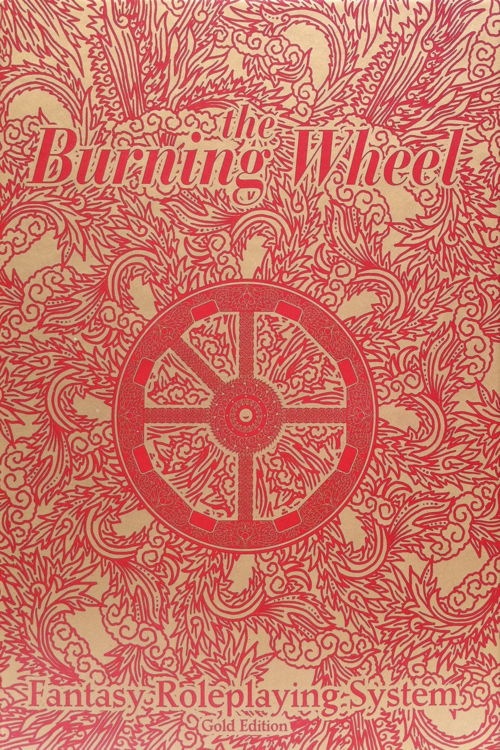
The REAL Burning Wheel Gold Review


OK, so I posted a review of Burning Wheel Gold at the beginning of the year, but it was based off of a few read-throughs and playtest reports from forums, so no personal experience to really relate to anybody. It's been 10 months and I've had quite a bit of time to run not just Burning Wheel but Mouse Guard and Burning Empires. So, here's my review, after 10 months of being soaked up in Luke Crane's work, and what do I think?

This is a truly remarkable game. There are some parts of the game that I'm not a particular fan of (character creation, you giant pain in the ass you), but the things that Burning Wheel sets out to do it does so well that I'm in awe of it. What does it set out to do? An RPG that will make stories similar to Lord of the Rings, the Earthsea Cycle, the Count of Monte Cristo. What does this mean? The RPG is designed to give you a story that will be long, character-driven, and fun, while keeping the sanctity of the character not being you, but someone who you watch develop and become attached to. This last point is probably the most important difference between this and other RPGs. We'll get back to that in a little bit. 

Burning Wheel is a D6 dice pool-based system. You roll a number of six-sided dice equal to your number in the skill, and try to roll a number of successes equal to the obstacle number, or Ob. If you succeed you get intent that you originally stated, carte blanch If you fail, however, the GM instead gets to muck with your original intent while making sure the plot still moves forward. Failed your Power check to knock that door down? Oh, you get the door down, but you attract the attention of your hated rival, who has been following you the whole damn time. Or the guards. Or your father, who owns the facility. Y'know, something awful and unforeseen but that doesn't get in the way of the narrative. These results stand for the entirety of the session, thanks to the Let It Ride rule, which states that all die rolls, unless changed, stand. So if you failed that Power check, all applicable Power checks fail until the situation changes or the end of the session. If the GM can't think of an interesting failure for your task, you automatically succeed.  Notice that interesting should mean something linked to your Beliefs, Instincts, and Traits, also known as BITs.

Oh, right, BITs. I should probably explain those. 

Beliefs, Instincts, and Traits are the things that make the wheel turn! These determine not only characterization, but where the plot will go, and what hooks the players and GM will be able to pull on to make the story move. Beliefs are an ethical statement with a specific plan of action attached to said Belief. This is where you get to state what your character is about and what he is going to do about it. Instincts are those little things your character has learned to do in the course of his life that aren't necessarily the best things to do, but he does them anyway (like "Never accept an insult"). Traits are personality traits that you are the embodiment of, for good and for ill. 

You then get rewarded for playing out your BITs with something called Artha. Artha are points that you get for role-playing in such a way that the story moves forward. There are three types of Artha: fate (for playing out your BITs, especially to the point of trouble!), persona (for fulfilling personal goals and breaking free of your BITs), and deeds (going beyond your own problems and helping everyone in a heroic fashion). Artha may then be spent to improve your dice rolls so you can get what you want. If you're playing the game correctly you find that you've got a good story-game, filled with drama and tension as you earn Artha for playing out your flaws and spend said Artha so you can get your goals accomplished. 

That's essentially the game in a nutshell, folks, but there's a bit more to it. Burning Wheel has a lot more to offer, and this is where a lot of people have issue with the game, because Burning Wheel refuses to do anything like any other RPG I've ever seen. This is good, because the mechanics are exactly suited for the game, but bad, because the mechanics are just enough out of the norm to get some rather significant balking from people, particularly RPG vets. If you've never played an RPG before this won't be as much trouble, but the next section is a bit more for the people who have issue with the following mechanics. 

Burning Wheel has a series of extended conflict resolution mechanics that are based off of the same basic idea. You construct a series of actions from 3-9 moves ahead of time, and play them out against your opponent, who has done the same. These moves are then resolved in a rock-paper-scissors format. This is done for two very good reasons: it puts a very strong tension into the conflict and it keeps the sanctity of player-character separation completely intact. I have never had so much tension as I've had in a single Fight! or Duel of Wits, because you genuinely have no idea what is going to happen next. I've seen conflicts turn around so quickly it makes my head spin. And again, this reinforces the fact that you are not your character, something that is critical to making this game run. Why is this critical?

Burning Wheel is designed to be resolved in 30+ sessions, and some games last years. You are watching a character evolve for a very long time, and, quite frankly, that can be a little dangerous without the proper distance.People get all wrapped up in their characters all the time and that's a bit unhealthy. Burning Wheel recognizes this and makes sure that you will always be a spectator of your character's actions, not a perpetrator.

Now, on to the thing I don't like about Burning Wheel: length of character creation. What you do is you put together a basic history of what your character has been doing all the way up to the beginning of the story in what's called Life Paths. It's a fine system, and is frankly quite awesome, I just don't like how long the ****ing thing takes, especially with beginners (myself included). It's taxing and exhausting, and sometimes is just infuriating how detailed it is. But, the thing is that all these parts are necessary to make the game work in this particular way. 

And that's the last thing you need to know about this game: it is NOT for everyone, and was never intended to be. Burning Wheel is heavy, crunchy, finicky, intense, and very particular. If you read this review and find that some of the things in this game really don't jive with you, that's fine! Burning Wheel is not the only story-based game out there, but it's a really awesome one. Do NOT buy this game looking for a catch-all RPG, because this isn't it and, let's be honest here, such an RPG doesn't really exist (no, not even DnD). But if you're looking for a game that will give you a story like the Lord of the Rings, the Earthsea Cycle, and the Count of Monte Cristo, this is that game. It's only 25 bucks for an awesome hardcover, and I cannot begin to tell you how excited this game makes me on a weekly basis.