Friday, September 25, 2015

Modern Spidey is... What?


The first time I saw the red and blue costume I was hooked. The wall crawling, the jumping, the swinging on webs high above the city streets... t'was amazing to even think about for my four year old self. As I grew older I found that the character I'd attached to had a surprising amount of depth. Peter was someone who was committed to being a normal man and a hero. He didn't care about saving the world, the world seemed to be doing very fine on it's own. He just wanted to get a job, marry Gwen, and settle down, saving the people around him as he could. Peter Parker just wanted to live.

Well, then One More Day happened, and Marvel sold Spidey's soul to Joe Quesada. I stopped reading immediately. This was not Spider-Man. I'm sorry, but Spidey doesn't make deals with the Devil, particularly when most of the arc that Straczynski had been running about been about Spidey's questioning of the mystical! How's a guy who has issues with the concept of God going to make a deal with the Devil? Not that Quesada cared.

Yes, this is still a sore point for me, deal with it or stop reading. I really don't care.

Anyway, I refused to read after that until I heard about Slott's run from a friend of mine. I was told that the stories were really good and that I was missing out. This friend of mine has good taste, so I decided to give it a shot. And y'know what? They were really good stories. Peter was finding his feet as a scientist and hero and he was knocking it out of the park. No, it wasn't my Peter. Peter is married to Mary Jane in my 90's kid memory. But it was a good facsimile of Peter and that was good enough for the moment. Heck, my hopes were raised with "Renew Your Vows", where we see Peter and Mary Jane married again with a daughter, Annie May.

But now Slott has come out and said  that the new volume of Amazing Spider-Man will focus on Peter Parker as a billionaire gallavanting around the world with a Spider-Mobile.

No, I did not just make that up. Peter Parker, the guy who just wanted a normal life, all of a sudden a billionaire and globetrotter, with a friggin' Spider-Mobile??

I have never seen a more drastic mistake on what makes a character tick. Spider-Man, contrary to popular opinion, is not a coming of age tale. It's the story of a man who tries to be a hero for the people right around him. The early issues work because they reflect where Peter is at at the time: he's a lonely teenager who's way too friggin' smart for his own good and trying not to turn into the crazy villains that he keeps running into. He's meeting twisted funhouse mirrors of himself and learning how to be a better person from it. The reason why the marriage was done is because Peter, being the Everyman, is logically going to get married, since it's the most common thing we do. Marriage is the bedrock of humanity, and since Spidey is explicitly stated as the Everyman it makes sense for him to be married and evolve in that way. The villains naturally would need to change to suit and mirror Peter's struggle like they did at the beginning of his career, which would bring new variety and allow for the title to grow instead of stagnating like it has been.

But, instead, we're getting Spidey globe trotting as a billionaire with a Spider-Mobile. This is not right. This is not my Spider-Man. It hasn't been ever since One More Day and, no matter how hard I wished for Big Time Spidey to be the hero that I had missed, Slott doesn't seem to understand the character anymore than Marvel does.

So, what would my Spider-Man look like?

Well, Peter being married to MJ again would be a no-brainer and they'd have their child. Aunt May would be dead, and so would Harry. So, for starters, J.M. Matteis's beautiful work wouldn't have been undone. But it would be more than that. Peter's too good a guy to not try to take care of New York however he can. Being a schoolteacher made a lot of sense for a man who never wanted to look away from trouble ever again and it would begin Peter's transformation into his father figure, Uncle Ben. The left over villains from Spidey's earlier times would then begin to try to form families of their own. Vulture with his little Vulture-lings, Doc Ock trying to form a nation out of Manhattan that would worship him in the way he always wanted, Alyosha Kravinoff trying to figure out who his father was (by means of torturing those who knew him like Chameleon and Spider-Man), things like that. On the home front Peter would be trying to adjust to having a baby and all that requires: do they use formula? Cosleep? Does MJ want more help with the baby, which cuts into Peter's night-time patrols, thus raising the crime rate and triggering Peter's guilt complex? What about the days when MJ just wants a a day off and Peter's already so exhausted he can't give her one, or doesn't want to?

See how I, a blogger sitting up at 11:30 at night with a computer, came up with all that in a few seconds? I literally just rattled that off the top of my head. That's good character based drama right there, all within the Spidey mythos. It would be amazing to see. But instead we're getting a Spider-Mobile. It almost makes me wanna write the thing myself, just so everyone could see what I'm talking about. Spidey isn't about riches, fame, or glory. That's Iron Man's M.O. Instead, Spidey is about the little man doing the little things that mean the world to the people around him, who happens to have the ability to stop a rampaging Rhino and does so because none of the Avengers are around to do it. That's my hero. That's my Spidey.

A note to Dan Slott should he find this: I know what you'll tell me should you read this. You'll tell me to wait and read. Which I might do, depending on my budget. However, please don't miss my point: Spider-Man is about a normal dude who is a hero to those immediately around him. I know you reference as much as you can from the Lee/Ditko/Romita era as you can, but that part-the most important part!- seems to have been left out. It's what made Spider-Island so great: Peter impacted those around them and made them all heroes, right along with him.


*****
It's another sleepless night guys! I lay next to my lovely wife and son, listening to them breathe, for about twenty minutes and realized that I had more to say about this subject. Well, more of an announcement to make.

I'm gonna start writing the Spider-Man I wanna see, right here on this blog. Here's the skinny on that.

  1. That it'll be any good. Don't get me wrong, I'll try my darndest, but I'm not Matteis, Slott, or Lee. Not by a long shot. 
  2. That it'll last forever. It most probably won't, cause at some point I'll have said whatever I wanted to say about Peter Parker and then I'll be done. It'll be one more project talked about on this blog.
  3. It will start shortly before Mary-Jane gives birth to her and Peter's kid. Aunt May is dead. So is Norman and Harry Osborn. So is the Jackal. Ben Reilly is around, only recently having returned from his wanderings. No sign of Kaine, although I can't guarantee that'll be a permanent thing or that he'll be like what we're used to in the comics. Doc Ock is still alive and has no idea Peter is Spider-Man. 
  4. Dead is friggin' dead. 
  5. While I may borrow some elements from modern comics I will change anything about character's backstories that I so wish. I will not be sticking with preconceived notions of the characters, not by any means. So just cause it's been done in the comics does not make it canon for this little fanfic.
I have no idea how long each individual chapter will be, but you will hopefully get a chapter once a month. Chapters will be divvied up into books, which will last one year at a time. So, starting in October or November, you'll see the first chapter for my take on Spider-Man. What'll this new part of the blog be called?

The Amazing Spider-Family, of course! Stay tuned sometime in October!

Friday, September 18, 2015

13th Age Paladin


13th Age is an amazing game. Combining bits of indie story-telling with kick-ass action from the other d20 games 13th Age is easily the best of the modern d20 games (in this humble blogger's opinion). Each of the classes to fit around a different theme. They fit together pretty well...except that blood paladin. What is with d20 game and their inability to get how a paladin operates?

Out of all the d20 games I've played I've felt that 4th got the paladin the best, warts and all. The paladin in 4th edition was the rockstar of the figher classes, taking on crowds and laughing with impunity as the hordes crashed against him like waves against a rock. Sometimes I'd leave my DM speechless with how much damage I'd soaked up for the rest of the party. I would usually take double my full HP a battle and would not need to heal afterwards! Things like a critical hit would make me wince, sure, but it was only a flesh wound and my paladin could (and did) walk it off. Not that the paladin didn't have any weaknesses. A radiant-resistant enemy could laugh off my mark and my paladins went through healing surges (the recovery method in 4th) like a Russian did with vodka. The adventuring day would end because my paladin had run out of surges and could no longer block for anyone, nevermind protect himself in the midst of battle. Paladins also require a very competent healer to back them up as they play front man because, unlike the other defenders, paladins would pick fights with whole swarms of bad guys and needed the group to make sure he wouldn't fall flat on his face. It took a lot of trust to play a paladin, because if your teammates didn't back you up you were dead very quickly. Fortunately that was never a problem, as the other players were relieved to not need to spend more than two healing surges after each battle.

I don't get that feel in 13th Age. I just run in and smite things. The impression I've gotten from the online 13th Age community is that they're just as unimpressed as I am. So I decided to hack it. After talking with Andy and having some frank discussions about the state  of the Negative Zone this is what was cooked up. The following is a class feature:

Divine Challenge: Whenever you engage or are engaged by an opponent you gain temporary hit points equal to your Charisma modifier plus your level. Apply the double and triple rules for the Charisma modifier as normal. Temp hp gained this way stacks with itself. This caps at half your HP.

In addition, Smite has been renamed to Channel Divinity. You can either gain the bonus to damage as stated in the class feature or your can use it to burn a recovery. The feats that increase damage also increase healing by the same amount.

The class feature was designed with a meta in mind. Paladin players will be looking at this class feature and thinking "MOOKS!". Good. The intent is for paladins to throw themselves into battle against their enemies, shrugging off damage and tying up their foes while healing off wounds that should kill them and killing them as fast as possible.

Obviously, this is not playtested. I haven't gotten the math crimped down, nor do I know for sure how this will affect paladin play. If anyone reading this blog does try it out on their paladin please let me know, because it might be a while before I get around to testing it!

Remember, if you ain't charging into battle with the brazen faith that your god will protect you you ain't a paladin.

Friday, September 11, 2015

Spyder's Burner: Beliefs

So the other day my Burning Wheel group finally got back together to play. Most of the players did alright by themselves, around two or three fate and persona which isn't half bad. One of the players, however, managed to get four fate and four persona. One of my players looked at the session and commented that the session had been designed around this person. Which, to a certain degree, was true. The player had had a really specific situation handed to him on a platter at the end of last session... but then I looked at it again, and noticed his Beliefs. Every single one of them was organized around one of his Beliefs. It's not an exaggeration that his entire character was wrapped around one central Belief: become the king.

As I contemplated my player's actions my mind drifted to the other Burning Wheel games. Now, I know that the Adventure Burner says not to borrow rules from the other  Burning games, since they were designed with a different emphasis in mind, but that doesn't mean I can't look at the other games to see commonalities. And there are more than a few. However, the greatest philosophical commonality of the Burning Games, aside from the base dice rolling mechanics, is the importance of the session. Goals, when made in the other Burning Wheel games, are to be accomplishable in the session you make them. The rest of the mechanics work around making that a reality. Why wouldn't it be any different in Burning Wheel? The mechanics support that style of play the best from my understanding.

So, here's my thoughts on what that means. Beliefs are very hard things to nail down, but if I had my druthers (and with my players I do :P ) I would recommend trying this out:

  1. Your first Belief is the Vector (goal) Belief. This is something you mean to accomplish this session. Yeah, right now. This absolutely has to happen now. Go do it, now. This is the thing you're doing tests over and bleeding for. I call this the vector Belief: pick a direction and go.
  2. Your second Belief is the anti-Vector. Your character has some doubts on whether what he's doing is the right thing or not. Or maybe what he's trying to do grinds against him somehow. Cullen Bohannon's first arc in Hell on Wheels is the epitome of this. He's actually a very honorable man, but the death of his wife had filled him with so much rage that he couldn't see straight. So his better nature would call out to him, eventually leading to his redemption. I'm not saying everyone has to do exactly what Hell on Wheels did, but there needs to be something to grind against. Character growth is uncomfortable in real life and it's just as uncomfortable for your character. There is something he must do, but is it really the right thing to do? If given the chance will he abandon his post? I suggest very heavily tying this Belief into a Character Trait, it will make play a bit more organic.
  3. The third Belief is your compass. The tried and true thing that has always gotten you through every trial. This is your fall-back. When in doubt consult this Belief. 
  4. Have a Fourth Slot? This functions as per the Trait.
I'm thinking on my next Burning Wheel session I'll be playing with Andy (if that ever happens, thanks to bad work schedules). What should my character Tomar do? Now, at this point there's this dude called the Westlord destroying the kingdom Tomar lives in. Tomar, the bastard son of a local lord, has found out that he and his half brother share the blood of the true king. He also knows that the Westlord is taking over his city. Here's tentative Beliefs for the next session:

  1. The Westlord is destroying everything and, while I approve of his methods, I can't approve of his actions. I will find the general leading his campaign against my city and kill him.
  2. Nothing in the world is as disgusting and dishonorable as sneaking around.
  3. **** the government, I'll do things myself. 
That's a very clear picture I've given Andy to work with as far as challenge Beliefs go. Tomar believes himself to be a monster like the Westlord but wants to stop him. However, he doesn't want to sneak in but fight his way through. By himself. If that's not a series of hooks for Andy to challenge I don't know what is. Assuming I keep these (and why not?) it should be a very entertaining session of Andy trying to get Tomar to not only sneak into the camp but to do it with the government's help. A good session is in the makings right there.

Let's have another example, shall we? Let's say we have another campaign with a duke and I'm playing his brother who hates his guts cause he's a jerk and does all the poor folk my character's grown up with. So I decide I need to write some Beliefs.

  1. I will topple my brother the duke no matter the cost.
  2. Kurim, my contact in the court, is a noble man. I owe him much for all the kindness he's shown me and I will repay the debt.
  3. Assassins are the lowest scum of the earth. They took my mother.
Again, you've set your bait for the GM to chase after. The duke needs to go down, no matter what. He's such an evil bastard he needs takin' out, NOW. However, there's a man in the duke's court that's a good buddy and my character hates assassins because they killed his mother, probably at the purview of my brother. Now that's something the GM can really bate.

Now, one of the things you should do as a good player is to try to get the other players involved somehow. Write them into your goals if you can, get them mixed up in your business, or make Beliefs about they need to stay out of yours. The GM should do his level best to make everyone's business go together. Somehow. That's part of what makes being a GM fun...

Do you have to do it exactly like this? No, not at all, but I really do think the best way to make Beliefs work is to make sure they can all be activated in one session. The best sessions I've had in Burning Wheel so far have followed this pattern. Have different experiences? Please post and comment, cause I'd love to hear it!

Friday, September 4, 2015

East and West: The Liturgical New Year and the Theology of Mary


Welcome to yet another intermittent column as I compare Eastern and Western Catholic and Orthodox theological stuff. I'll look at things from liturgical celebration to theology to private devotions and go compare and contrast them.  Sometimes things'll look different, and sometimes they'll be much more similar than anyone who believes we shouldn't be reunited would like to think. Up first: the Liturgical New Year!

Everyone say Happy New Year to the Byzantines and Orthodox who are on the New Calendar! September 1st is the first day of the year liturgically. The beginning of the Eastern New Year is linked with the seasons: much as the beginning of the day is the setting of the sun so the beginning of the year is the end of summer and the preparation for winter. 

Sorry, couldn't resist. For those of you who don't like mixing theology and humor I am truly sorry for you.

The Gospel reading of the feast is Christ standing before the synagogue declaring that He, the Messiah, has come and the work of God has begun.

"On Mount Sinai You gave the stone tablets
Today in Nazareth You read the prophecy
O Christ our God in the flesh.
You took and opened the scroll
to teach the people that the Scriptures were fulfilled in Yourself"
(Stichera from Vespers)

We are to pay attention to Christ, Who is the center of all Scripture that we are to read for the year. The year is dedicated to God. The East also shows us St. Symeon the Stylite, a great ascetic who spent his life on a pillar, away from everyone. The year is to be dedicated to God for His kingdom is outside and inside our hearts. 

This contrasts with the Roman Calendar, where the New Year is the first Sunday of Advent, the beginning of the fast (Put the eggnog down!) of Advent, which focuses on the parousia of Christ in all three year's readings as well as the Liturgy of the Hours. The West looks to the two comings of Christ with eagerness and hope.

"We do not preach only one coming of Christ, but a second as well, much more glorious than the first. The first coming was marked by patience; the second will bring the crown of a divine kingdom."
-Saint Cyril of Jersualem, from a catechical instruction quoted in the Office of the Readings

Another thing I noticed when I looked at both halves is the context that the liturgical New Years are placed around. In the East you have the Birth of the Theotokos on September 8, followed by the Exaltation of the Cross on September 14th. In the West you have the Immaculate Conception on December 8 followed by Christmas on December 25th. In fact, come to think of it, September and December are the only months of the year that begin with a Marian feast and end with a Christological one, East and West (meaning January, which has the feast of Mary followed by the Epiphany, doesn't count, although the fact that  it marks the start of our secular new year reinforces the theme even more strongly). It's almost like they're saying that this is the start of salvation history or something. 

"By Your Nativity, O Most Pure Virgin,
Joachim and Anna are freed from barrenness;
Adam and Eve, from the corruption of death.
And we, your people, freed from the guilt of sin, celebrate and sing to you:
The barren woman gives birth to the Theotokos, the nourisher of our life!"
-Kontakion of the Birth of the Theotokos


"Through the fullness of the grace that was given you, dead things rejoice in their freedom, and those in heaven are glad to be made new. Through the Son who was the glorious fruit of your virgin womb, just souls who died before his life-giving death rejoice as they are freed from captivity, and the angels are glad at the restoration of their shattered domain."
- Saint Anselm, from the Office of the Readings

Huh, how 'bout that.

It's interesting how it all lines up, isn't it? To the Church the beginning of Christ's salvation is with His Mother who, because of her yes, made all that followed possible. The whole world is indebted to Mary and so should celebrate her existence. To the East it's in her birth, that meeting of Joachim and Anna and Mary for the first time. To the West, it's the lovemaking of Joachim and Anna and God's favoring of it. Both are starts and, as a new parent, I can finally see why the East might prefer the birth over the conception. But there's something special about the conception as well that's amazing; the secret beginning that can only be known by you, your spouse, and God. Both are beginnings in their own right. The beatific vision of a child's face or the whispered secret that heralds the dawn.

But the Marian event is not the only special thing that goes on in both months. You also have the Exaltation of the Cross and the Nativity, both of which are 1st class feasts in the Eastern Church. The West doesn't emphasize the finding of the true cross quite as much, which is odd considering their emphasis on the Crucifixion, although they have Corpus Christi already, so I suppose they emphasize the Cross another time of the year with gusto. The Feast of the Exaltation of the Cross can be considered a type of the Incarnation: after all, who could possibly doubt Christ's life if we actually found the cross that He died on? The concreteness of the Faith is the most important element. After all, if we didn't have proof that God became man then what's the point of being a Christian? The East does this by saying: "Here's the cross, centuries later! How much more proof do you need?" and the West answers with a just as pertinent Feast Day that proves the historicity of Christ. God became a baby. A perfect little baby, literally. Both feast days are proofs of the reality of our Faith.

Ultimately, then, the Christian faith, East and West, begins with the following statements: God is man. He had a mother. He was here, He is historical. Christ is real, and He is coming into our hearts. It's the same doctrine but different ways of expressing it. It's almost like we were commenting on the same reality but in different ways, like men and women.  And, to be even less subtle about it, it's almost like both ways really are just a matter of preference: you're still celebrating Mary and Christ. I'm not saying the differences don't matter but it's the similarity between East and West that needs to emphasized, now more than ever.

Friday, August 28, 2015

Why I Prefer Marvel Movies to DC Movies...So Far (With an Ant Man Review Too!)


I saw Ant Man the other day, and, while waiting for yet another superior Marvel film to play, I saw the trailer for Batman vs Superman: Dawn of Justice.

What was that crap? It's the only trailer I've ever seen that I felt an innate need to flip off. Well, until I saw this one:

Dark, boring, brooding... yuck.

Now, anyone who's been in any RPG campaign with me knows I don't shy away from dark. Hell, I dive in head first with a gusto that alienates people from time to time. Because who wants to play in a game where the main villain is an aborted god who wants to rape his half (non god) sister so he can take over the baby's body so he can have another shot at the life he was so unjustly denied? Amiright? So what's so different here?

Part of it has to do with the inability of the producers to get what the characters are about. Superman is about God among us. Pure and simple. He's a man who has the powers of a god who believes in us more than we know how to believe in ourselves. He doesn't feel loneliness from being an outsider, because to him all people have a common good that needs protecting, himself included. He doesn't see the differences so much as he sees the similarities, even in the face of overwhelming evil.

Where was any of that in the Man of Steel? Where was Superman?

Sure, he saved people, because it was the right thing to do. But there's a basic satisfaction in doing good for it's own sake that's simply ignored by Snyder and co. Don't get me wrong, some people do respond to being saved by being untrusting and bitter, but that's only one part of the picture. There's a basic commonality we all have that Snyder, in his infinite wisdom, ignored for the "gritty for it's own sake" feel. If you're going to be dark actually be friggin' dark! Do something that requires the darkness be felt! Threaten things and people the characters care about, not this "I'm brooding for it's own sake" crap we got in Man of Steel.

Guess what we got more of in that bloody trailer?

"It's man versus god, night versus day."

Who talks like that? Someone in the theatre asked if that character (Lex Luthor) was the Joker. I almost told her it was. I mean, Luthor may as well have been the Joker. All DC movies apparently think heroes and villains are the same. It's just a mess of gray. And don't even get me started on the Suicide Squad. Monsters doing monstrous work is such a spirit of the age thing it isn't even funny. I guess I could go all Valley Girl and say "That's so 20th Century guys!" because it really is. Yes, I get it, producers: World Wars I and II sucked and we found out that progress for it's own sake creates monsters, and that it takes monstrous acts to sustain our civilization. Thank you for the revelation, the blood of millions of aborted children is heard already, let's move on.

I guess when I think of dark things I think of something like Children of Men or, more aptly, the Nolan Batman films. Now those are dark films that deserve the title! Their protagonists actually have interior and exterior problems. Theo is living in a world where all the women have become infertile and lost one of his babies to illness. That's not brooding for it's own sake, that's plain old depressing. Bruce Wayne lost his parents as a child due to his fear and now refuses to do the same thing with Gotham. He's got a guilt and inferiority complex miles long and the movie reflects his failings as he attempts to be a hero. He accomplishes the impossible, interiorly and exteriorly, and that makes him mighty. He actually does stuff that makes us wonder, whether it be fight ninjas or shut the lights off in Gotham or face down the League of Assassins not once but twice!

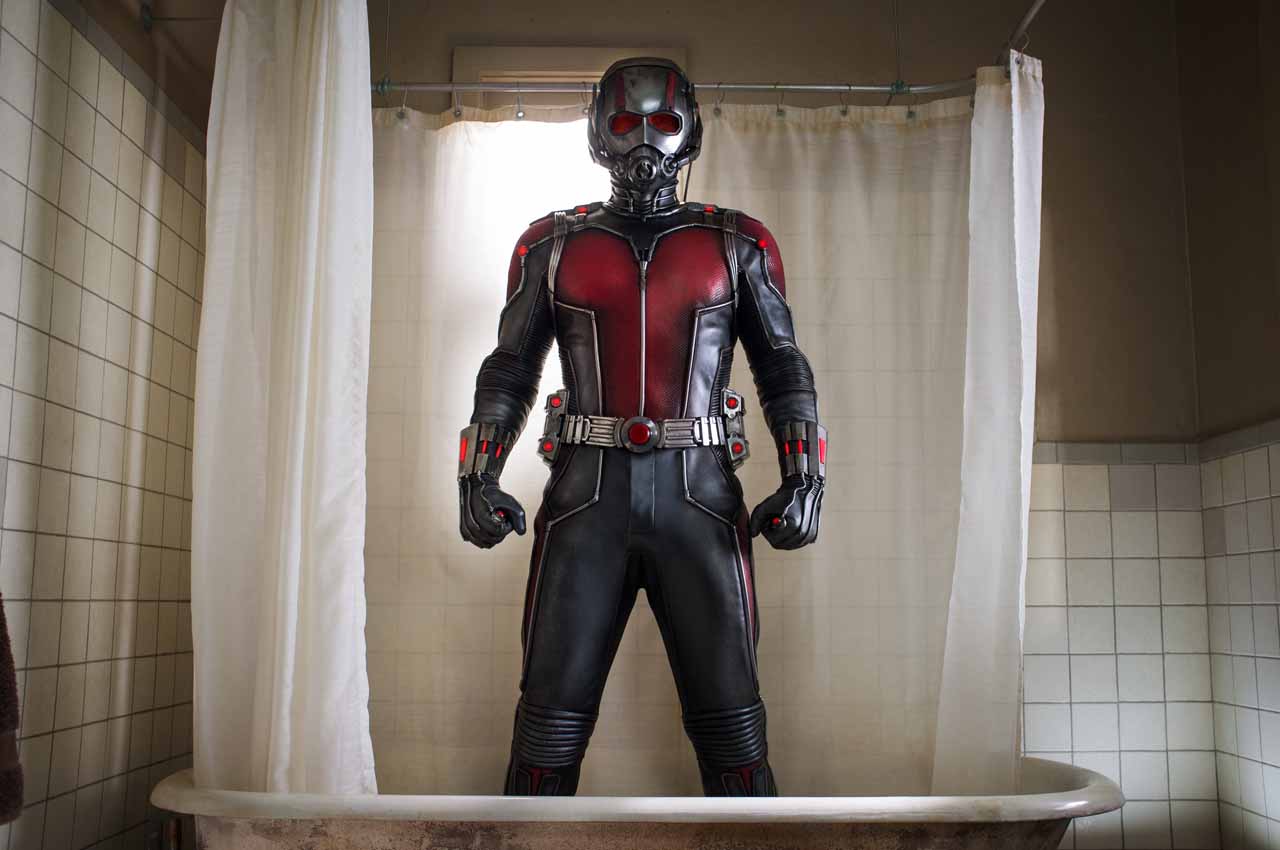
That segues pretty nicely into my review of Ant Man. Boy, DC, if you want us to root for your movies don't put your trailers in front of a superior product, particularly Ant Man. Paul Rudd plays Scott Lang, a modern day Robin Hood who got caught, chosen to be the Ant Man by Hank Pym, a hero of WW II. The whole film asks "why this dude?" and then answers the question. Scott Lang is a man who acts because he must, not because he wants to. Everyone in the movie keeps asking the Scott the same question: "What makes you worthy of being the Ant Man?"

The fact is that it's love. Scott wants to be with his daughter who has been separated from him because of his failed Robin Hood antics and he just wants to be near her again. Scott is extremely human in his motivations and is nothing if not rootable. He actually gets something out of his heroism, it's something he actually needs. Being a hero makes Scott a better person, thus completing the heroic cycle that all the Marvel movies have set up.

And I guess that's the thing that Marvel gets right that DC still hasn't figured out: being a hero can actually make you happy. Is it easy? Is the burden light? Will things go smoothly? No. But, in the end, there is happiness. It's what they were meant to do. And, in DC's just randomly awful universe, power has no good use. It's just something you're burdened with until it either drives you insane or you die from it or you run away from it, giving it to the next poor sap. And yes, that can be true. But someone as powerful as Superman has a reason for saving the human race instead of destroying it, and I'll be darned if Snyder and Co. know what it is. I'm fairly certain they don't, and never will. That would require them knowing what a hero's about.

Thursday, August 20, 2015

St. George and the Dragon, ISIS, Planned Parenthood, and Why I Might be Turning Into a Pacifist


When I was a kid one of my favorite books was St. George and the Dragon. Beautifully written, gripping, and I suppose it shaped a lot of how I expected wrong things were to be dealt with: head on, with God's help, and a whole lot of blood. My poor action figures never made it past a year they were manhandled so roughly. But that was the price of fighting evil in my little five year old mind. You generally got broke doing it. Not that divine help wouldn't come. In my childish wisdom I'd tape the action figures back up and send them back out into the fight, where they fought just as hard as they did before. It wasn't until every last bit of that action figure was useless that I threw the thing away, and even then I'd probably hang onto it.

Yeah, I was a weird little kid.

Now, sometime in my childhood one of my friends molested me. I didn't know what I was doing, who does at the age of eight? But that's what had happened. Once I realized that something was wrong with what we were doing I stopped it and the "friend" turned around and helped start up a neighborhood-wide five year stint get-Nathan-campaign. For five years they tormented me and my siblings and for four years I tried to get them to stop. These had been my friends, after all, and I wasn't quite ready to give up on them. Somewhere along that way I finally put two and two together and realized that not all dragons look draconic but wear human suits. By that point I'd had training in Muay Thai and used my abilities to my advantage. By the end of my time there I stalked my neighborhood, not the other way around.

It was one of the most profoundly hollow experiences I've ever had. What did I gain by hurting, cajoling, and threatening the people who had hurt me and mine? After that quick satisfaction anyone gets from righting a wrong there really wasn't much to be satisfied over. I had become someone who could scare a neighborhood. Wonderful. Some Saint George I'd turned out to be.

Sometime after that I finally (after three tries!) read The Brother's Karamazov, which answered a lot of the questions I'd had for awhile. They weren't new answers, just repackaged in a way that I could get: we're all one family and the response to wrong doing has to be love and forgiveness, for everyone's sake; judgment and violence really get us nowhere. It's not a pill I've swallowed the whole way, it still needs a lot of water to wash it down, but it's stuck in my throat somewhere, uncomfortably.

That's when this whole thing with ISIS started happening, and women and children started getting raped on massive levels. Oh, I won't pretend to know the depth of despair that they're going through but, as a sexual abuse carrier who still grieves the event, I feel desperately sorry for them. If the pain and anguish I feel some days over what happened is any indication of what they're feeling, any indication at all, I don't blame them for wanting to commit suicide. I don't blame them for losing hope because what's more hopeless than having your own sexual autonomy destroyed? There ain't much. And yes, I'll admit it, a part of me wants to go over there personally and blow those ISIS animals to hell and back. Who deserves death more than a sexual molester? Particularly a whole army of them?

Sometime after ISIS started it's terror campaign (that our fearless leader ignores) we had Micah. My goodness, I can't believe how amazing it is to have a baby! Every day he's just happy that I'm bloody there in his life. Me. His dad. There's something profoundly humbling in that all he cares about is if I'm happy and if I love him. The lack of symbols to distract him from that love is incredibly disarming, because I can't talk useless words with him. All I can do is show him that he's loved. And he knows when he's being lied to, so I'd better mean my smile from the bottom of my heart. Nothing has changed my life more than becoming a father.

And THEN the Planned Parenthood videos came out. I will admit it flat: I haven't watched them. I've read transcripts, reactions on both sides, and got sick just from doing that. As a Catholic I believe that abortion is wrong. I have prayed in front of abortion clinics, held up the signs of bloody dismembered babies on Good Friday on the highway, and attended two Pro-Life Marches on Washington D.C. So don't get me wrong, I've done something. It ain't much, but it's something. In the face of those videos it became a whole load of bunk. Every image and account I read I saw Micah's face and it prevented me from getting all the information that I, an adult, should get. But I really don't care. That's a step I can't take, not yet.

What led to this blog post isn't the first six videos, but the seventh, where a baby's face is hacked into to get at a brain and the heart is still beating. Yeah, I'm glad my stomach was empty, because just reading about it makes me nauseous. Such a profound disregard, which looks so familiar... what makes them any better than ISIS again? As Christians we're supposed to defend the weak and some of us believe in Just War theory. Forty years of dead children and why haven't we leveled every abortion clinic in America? We don't believe we can convince those ISIS monsters to change their ways, why do we somehow think the abortionists are any different? And why do we still teach our kids about St. George if we're not going to do anything about it?

(For anyone from the U.S. government reading my post and looking up my unit to let them know they have an extremist in their ranks, please put down the phone. I'm not finished yet. Cause I know someone from the government's reading this going "And we have an abortion clinic bomber in the making!" No you don't. Put the phone down and leave my bloody unit alone. Finish the blog post.)

I've been wondering how on earth to reconcile all this in my heart. This is a level of evil I find so staggering I can barely comprehend it, nevermind do something about it.  The fact that things are going on to stop it is irrelevant to me at the moment, because I think I actually have a much larger decision to make. Does violence solve anything? I have to answer a cautious yes. Defending the weak can literally mean just turning aside the blade ad nauseum. Shattering a limb is not the same as taking a life. Kneecapping may have a use. But killing? Revenge? I've never killed anyone, but there was a time I profoundly wanted and thought I needed to. And, from everything I've learned since then, I'm glad I didn't. It wouldn't have taken those awful experiences away, just given me a new one to deal with.

Besides, dragons aren't in human suits, they're much worse. We do have an Enemy and we can't kill him. Do I pray for him? I know some do. But do I? That's a completely different question. I'll ponder that at some point.

I guess that makes me a pacifist then. Those people who are murdering babies in the womb and then dismembering them and selling their body parts so they can get cars out of the deal are my brethren. They're in need of saving just as much as me. So's the kid who molested me. He needs saving too. Prayer does work, clinics have closed and hearts have been opened. Abortion was already being attacked on a massive level before these videos. I'll do what I can to make sure it ends and help those who have suffered from it, regardless of the blood. It wasn't too long ago that I wanted blood on my hands too, so it's not like I can judge.

Yup, that makes me a pacifist. Heh, my mom's gonna kill me. The irony of that previous statement is not lost on me, either. Good thing I'm twenty seven, long out of the womb, so now it counts as a murder in this barbaric nation. Now please excuse me, my wonderful son is awake and wants to munch on my prayer rope. If anyone's looking for a toy for their children Eastern Christian prayer ropes make the best toys. They're nice and soft with a tassel that you can use to tickle your child's nose. Micah adores it.

Friday, August 14, 2015

My Approach to Making Tabletop Campaigns

How my players see me.

 Designing a tabletop RPG campaign is one of the most rewarding things I've ever done and it's something that's devoted a bunch of my time over the last eleven years. After fumbling around for about eight years I found something that works really well for me. Always remember that, if your players don't have fun with my approach that's OK. Different people have different priorities, so you really have to cater to their tastes. My method's pretty simple: I decide what type of story I want to experience with my players, find a song that gets the feel that I want to experience with my players, pick a game that make that type of story work the easiest, decide what the major themes of the game are, design a world that reinforces those themes, and come up with an opening scenario that'll kick-start the group into the adventure. These steps aren't necessarily in order, although I like to believe that I work in this order, more or less.

When I first start making a campaign I ask myself  what sort of story I would like to experience with the players. Contrary to popular belief a huge load of pre-session prep work does not help all that much if you don't know what you want the game to be about. Decide what it is about your concept that grabs you. This is what we will call the theme of the game. Make sure it's something specific so you know what you want to go for. "Trying to make the best out of a bad situation" is better than "hope", since with one you now know you'll be throwing really crappy situations at the players that they'll be unable to completely solve, whereas with the other you're a bit unfocused. And while that meandering sense may be fine for some players and games it's not really what I like to GM. I like to get right to the point and hammer it in as hard as I can.

The concept for campaign number one is pretty simple: the players are in a sequel to a previous campaign we'd played through, living in a city that was built to imprison an arch-demon. My twist on this idea was very simple: what if the arch-demon they thought they were imprisoning was free and there was a completely different demon they were guarding? That's a pretty horrible situation, so I figured that the game would be about coming to grips that they had the wrong dude and needed to adapt if they needed the save the city. I thought about it being sort of like the first season of Arrow or Eden of the East: how do you save a city? What actions must you do to save a city? What must you become to save others?

This is example number two. In this example the game comes first, not the concept: I really wanted to DM a 4eMOD game. DnD games have always been a very difficult thing to nail down: character classes make character creation much a more individual than group activity and it's always been one of the challenges of the d20 system. So this time I wanted to make a game where that was the strength of the story: disparate characters finding a common cause. 

My next step is to pick a game that mechanically reinforces the theme I just outlined. This usually means that I start with a game that I own  and, if it generally fits, modify it to until it gives me what I want. I modify with extreme conservatism unless I'm very familiar with the system. And, if I am familiar and need to hack it to bits, I do so. I never ever pick a game that doesn't have what I need at the core, however.

Since the previous game was a Burning Wheel game and since this one centers around character development and growth the obvious go-to is Burning Wheel again. This means that Burning Wheel is the defacto game to go to. I usually use every single bloody optional rule in Burning Wheel, so that's pretty much all the thinking I need to do about that. 

In the second pitch I hit a snag: all the stuff that I really wanted to do story-wise just couldn't be done in any version of 4th Edition. Heartbreaking as it was to do, I realized that I couldn't get the cooperative story-telling that I demand as a part of my games and play 4th, not without a whole lot of extra work that really turned 4th into 13th Age. So that's what I decided to do: play 13th Age instead. The good news is that anything from 4th that I really want mechanics-wise is very easy to port over to 13th Age, as opposed to the other way around, where 4th (even 4eMOD) would be unrecognizable to me. 

Now that I have actions that I want my players to do and a game that'll give them the ability to do those actions to the fullest extent I go and find songs for an interior soundtrack to help me keep the mood of those actions going. This is pretty loosey-goosey, but generally I'm starting to find that the song I start with is rarely the song I'll finish with.

For the Burning Wheel game I found a song that really inspired me in ways that I'd never even counted on: Falling Down by Oasis. It was so influential that I even named the campaign after the band! The game really fell into focus here: this was a tale of the miseries of trying to be a savior when you yourself needed saving. And that feel has stuck with the campaign ever since.


In the 13th Age example I've only just begun to think about the concept, but the song Politicians by Switchfoot really strikes me. It's not so much a case of finding something that "fits" as it is about finding something that inspires me to process the game more. And who couldn't get fired up from this song, really? I think I'll name the game "C'mon and Break Me". Certainly captures the feel that I want!


This is when I start working up a world that will facilitate the actions that I want to have the group do. To make players do the actions you want you need to create a universal need for that action in the world around them. Want a game of intrigue? Make the problems more subtle, harder to suss out without going into serious information delving and thus doing a lot of talking and politicking. Want high falutin' action? Blowing up stuff frequently and often, while introducing villains who don't want to talk, and you're on the right track.

In Oasis the setting is a long-running project that I've been working on for years: it's set in your "typical" pseudo-medieval world, but the catch is that there is a giant blue flame in the center of the planet keeping all good things alive.  Other flames exist that for various reasons, but the Flame is the reason why everyone gets to stay sane for another day. I decide that, in order to drive home the idea of interior corruption, to design a "zombie plague" that, as the players progress, find out really isn't necromancy, but is something much more sinister and terrifying. The central conceit of the setting is how to save a city, and thus yourself. So the threats need to be more centered around how to save people. Obviously the characters are gonna need some friends to save.

In "C'mon and Break Me" I decide that  I want to pick the 4e Forgotten Realms Setting, a vastly under-appreciated gem in 4e's crown that lets me screw around while sticking this story inside of the same universe as Oasis (the blue flame from the Spellplague ain't a coincidence). Threats don't care about salvation, they have a goal to accomplish that means everyone's death. Enemies are then nameless entities that you can knock over.

The opening scenario is the hardest part of this whole process for me. You have to make something that'll kick it off in the right direction. This sometimes means taking the time to set up a good situation, even more than what you spent prepping the rest of the game!

Prepping the opening situation for Oasis took a very long time! I had a lot of ideas but couldn't figure out how to best set up the situation. Eventually I decided to go with the grenade approach: threaten everyone and everything all at once. The town the campaign's set in riots after taking in so many zombie survivor refugees that the locals have had enough.

The 13th Age game is a bit easier to gauge: it's a combat game, therefore it should probably open up with a fight! I'd want the nature of the threat showing pretty quickly, so I'd just open it up with a fight with ghosts from the Shadowfell, intent on fulfilling their evil schemes. Right out in the daylight. Yeah, shades in the daylight. That'll work.

The last thing you have to do? Be ready to change your plans on the turn of a dime. No campaign scheme survives contact with the players, and frankly their plans combined with your plans makes for more fun than just one or the other. Learn to incorporate their actions and reactions into your long term plans, because you'll seriously enrich everyone there for doing so. Do not forget: you are not the writer of the story but the director. You take what the players do, add your own vision to it, and make it all one cohesive whole. Never, ever, ever, go against the players for the sake of story unless they're trying to destroy everything out of spite. Then you have a different problem altogether. But that's for another blog post.