Showing posts with label Star Wars. Show all posts

Friday, May 15, 2015

The REAL Star Wars: Edge of the Empire Review


Wizards of the Coast had a long and very successful run with Star Wars. I owned a number of their books, but never found much of a reason to run the game. I didn't quite know it at the time, but the mechanical similarity to Dungeons and Dragons is what stopped me. Don't get me wrong, I played DnD for a numbers of years, 4th edition in particular, but somehow I couldn't wrap my mind around the idea of using almost identical mechanics  for different stories. It just didn't make sense to me. Again, this is saying nothing was wrong with Saga (or any of the other things Wizards released), I just had a DnD itch already scratched. But what proper nerd doesn't want to run Star Wars in some way, shape, or form?

Enter the new Star Wars, managed by Fantasy Flight games. They came out the gate swinging with X-Wing, a first rate miniatures dogfighting game, and then announced Edge of the Empire, the first in a trilogy of role-playing games set between Episodes 4 and 5. Edge of the Empire is focused on the outer rim of the galaxy, far away from the bulk of the Empire.  That means that things are murky. You have responsibilities, obligations, problems. No one gets out clean.


Edge of the Empire has a unique dice system, as illustrated above.  Your six stats (Brawn, Agility, Cunning, Intelligence, Presence, and Willpower) generate green Ability Dice. Your skills let you swap out those green dice for yellow Skill dice, which have better symbols of success on them. The GM, in turn, has purple Difficulty Dice that can be upgraded to red Challenge Dice. Blue Boost Dice have a smaller amount of success symbols but might work in your favor. Black Setback Dice are the negative version of Boost Dice. You assemble your green dice and upgrade some of them to yellow dice. The GM then adds purple dice and might upgrade some of them to red dice, adding in blue and black dice at the GM's discretion. You then roll all of these dice and read the symbols on them to determine the result.

Using these results the GM and players determine what happens with every check. It's a bit time-consuming, but more than worth it when you consider the results. 

For instance, Jedi master Plo Koon is fighting young Boba Fett. After rolling  and cancelling out the results Plo Koon's left with a success and two threats. Plo Koon barely hits Boba but lost his footing for the next attack, giving Boba a boost die on his next attack.

This is not a dice system for those who simply want the rules to get out of the way. The dice mechanic is the entire reason to play this game and the authors make no attempts to say otherwise. I cannot stress it enough: the dice mechanic is the major hook of this game. Everything else revolves around it to the point where the game plays almost nothing like how it looks. And what it looks like is a traditional RPG.

Character creation is, again, pretty standard. You have your races  (which grant you your base stats and your starting XP), classes (which grant most of your skills) and your sub-classes (which grant you talent trees and a few more skills). You're given some cash to buy stuff and man, it's not enough. Neither's the XP they give you, especially when you realize that you can't raise your attributes/stats past character creation unless you buy super-expensive and hard to get to talents, and even then you can only raise one attribute/stat by one. And stats in character creation take the vast majority of your XP. Which is when the GM offers you the Devil's Deal: more cash and XP for Obligation. 

Obligation is your hook into the game. It's your character's bad past catching up with them now. Each Obligation is given a numerical value (usually 5-10 at the beginning of the game) and a chart is made combining everybody's Obligations. Here's my group's at the moment.
Jer'Ani (Bounty): 1-20
Kaneen (Family Curse): 21-30
Betsy (Betrayed into slavery): 31-40
Melody (Lost brother): 41-50
Zeke (Confirmed Jedi): 51-60
Jabba's Escaped slaves: 61-70
Wanted by the Empire for stealing Death Star plans and seeing the destruction of Alderaan: 71-90

As you can see you can also get Obligations from events you did in the game. At the beginning of the session the GM rolls a d100. If he rolls higher than the chart trouble doesn't come looking for the players. If he rolls any of the numbers on the chart, however, trouble finds the players, from whichever part of the chart that corresponds with the number. This stresses out everyone in the session, the person whose Obligation was triggered in particular. If doubles are rolled something really bad happens and the penalties are doubled.

For instance, at the beginning of the next session I roll a d100 and get a 22.  Kaneen's Obligation of his family curse has been triggered and, thanks to the fact that I rolled doubles, it's a particularly bad session for everyone. 

The GM can offer you more Obligation for more XP and cash. As you can see, Jer'Ani took me up on my kind offer. The Obligation system was a bit tough for me to use at first, but after realizing that that's the primary hook for the session (above and beyond anything else, regardless of what the book tells you), it got a lot easier to work with Obligation. 

Another meta-mechanic is Destiny points. There's Dark (for the GM) and Light (for the players) You can use these points to improve your own dice rolls, hurt another character's dice roll, or make up a small fact about the adventure that wasn't established before. You can only have 1 point spent per side on a single action. After playing it a few times my group and I found that this mechanic was great in theory, not so great in practice. Since you can only spend 1 point at a time it's really easy for both sides to spend a point and for nothing to change. Great idea in theory, not so great in practice.

Combat's pretty standard. You roll for initiative, trying to claim slots in the initiative order that you're allowed to swap with other players. There are two types of damage: wounds and strain. Wounds represent physical harm and strain mental harm. Wounds are harder to recover from than strain, which can just vanish after every encounter. Going down to 0 for either one will take you out of the fight. There's also a critical hit system triggered by Triumphs and enough Advantages, which makes you roll a d100 to determine what type of hit you just dealt/took. Even if the effects of the critical go away the actual status doesn't change until the critical hit is healed, thus adding a modifier to the next critical  hit roll. It adds up pretty fast and, coupled with the dice system, you get some really fun combats that are truly cinematic.

The final important thing is the XP system, which is frustratingly lacking. GMs are expected to hand out between 20-30 XP a session, for...well... whatever you want to reward them for. It's astoundingly loose and informal, which I don't personally count as a strength. You do get rewarded for following your Motivation, but that's all there is to it. It's not that the system's simple: it's simplistic and lazy. 

The bottom line is this: Edge of the Empire is an astoundingly fun system. The dice mechanic, the true core of the system, is a ton of fun and makes up for some well intentioned but flawed story mechanics. Definitely worth buying if you're into Star Wars or just like a narrative dice system.

Friday, April 10, 2015

Better Late than Never: Star Wars Machete Order


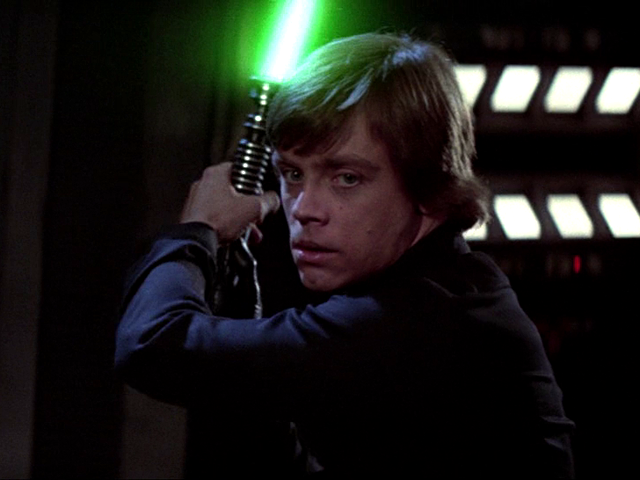
I've always liked Luke Skywalker. Something about the character has always appealed to me: the guy who just goes and does the right thing because it's the right thing, consequences be damned. The story of the original trilogy was Luke fighting to keep that passion throughout all the changes that were thrust upon him: the death of his family, the loss of the Hoth base, finding out that not only was Darth Vader his father but that no one else thought he should be saved. Luke's arc was about someone refusing to lose their innocence to the overwhelming darkness that had claimed his father. a man whom he struggled to be like in spirit but not actuality. 

And that's what I love about the Machete Order (Episodes 4, 5, 2, 3, and 6, the words Machete Order are actually a link): it deepens Luke's story. I watched this order with my wife Maria a few months ago (mostly against her wishes, Star Wars isn't her cup of tea). She watched it with me because I really wanted to try it and, while she had seen the original trilogy, she had never seen the prequels, so it made for some surprises for her. Episodes IV and V went about as expected: Maria tolerated them while I remembered what I loved about them in the first place: a simple tale about a boy who would be a hero. 

Then we started on II and things changed. Gone was the optimism, the spark, the charm, and fight scenes that actually seemed like fight scenes. In its place was depression, despair, weakness, and a whole lot of flash with no substance. But somehow it worked, especially Episode III, which saw Anakin's true trouble: he had no moral compass. Anakin, while phenomenally powerful, had no way to figure out what the right thing to do was. His relationship with Obi-wan was wrecked and perverted. He hadn't gotten the guidance he needed to become a strong person. So when it all came down to that fateful scene with Mace Windu and Palpatine on Coruscant, Anakin goes with the guy who promises to help him protect those whom he loves. The fact that Anakin had no idea what he was going to do up until that point is what  makes him such a flawed  and tragic character.

When Return of the Jedi came up the conflict became clear: Darth Vader was a hopeless, bumbling, incompetent, tragic man who had no moral character whatsoever. Anakin was no her until he saw Luke stand up to Palpatin. And that's when Star Wars finally crystallized for me.
I'd always felt that the trial of Luke during Return of the Jedi was odd, because Luke isn't the sort of guy who would just commit evil. That's not Luke's struggle, not really. No, what we were watching was Anakin finally being won over by his son, bit by bit. He put up a fight but Luke never gave up on Anakin, something that Anakin had never had before.  The struggle became about Anakin's redemption. Luke's almost suicidal trust in his father had finally paid off. Luke had won and it was well worth the wait.

I don't know if George Lucas has seen anything about the Machete Order, but I'm completely sold: this is the definitive way to watch Star Wars. It improves the original trilogy by putting two of the prequels in as backstory, allowingr you to enjoy Return of the Jedi for the masterpiece that it was always intended to be. Luke was always meant to save Anakin, that was the point. And the Machete Order delivers this in the clearest way possible.

Monday, March 5, 2012

Interesting Blog Post on Star Wars

This is pretty cool. It actually makes me want to watch the episodes all over again, in this order. Hell, even episodes 2 and 3. I'll have to try it some day with any future children I might have (although I'll definitely test it first).

Monday, February 13, 2012

Burning Star Wars SAGA: A Few Houserules


So here's a random idea. Light Side Points and Dark Side Points, tied into Beliefs. This is just a quick and dirty thought experiment, so it's not been tweaked or playtested. But I think it works really nicely for Star Wars SAGA, and would do tons for that game system.

I'll cover what the Points do first. The Light and Dark Side Points replace Force Points. When you make a character you divide up the amount of points you get from your classes between Dark and Light. You do not regain Force Points every level.

Light Side Points are a manifestation of the Light Side of the Force, and are extremely powerful. Whenever you use one you may either re-roll a d20 roll, amplify a Force Power (as Force Points normally did), negate a Dark Side Point (and nothing else), or regain your Second Wind. You regain Light Side Points by doing good deeds that threaten to complicate (and possibly end) your character's life.

For instance, let's say Han Solo hates the thought of Wookies being enslaved, so he helps save one's life. He gets kicked out of the Imperial Academy, but he gains a Light Side Point! Don't forget that the Wookie stuck with him til the end, too.


Dark Side Points are a manifestation of the Dark Side of the Force, and are highly corrupting. You may spend a Dark Side Point to add a bonus equal to 1d6+half-level to a damage roll, amplify a Force Power (as Force Points normally did), or regain your Second Wind. Whenever you spend a Dark Side Point you not only generate another Dark Side Point but you lose a Light Side Point. You get Dark Side Points by using Dark Side Powers and committing evil and selfish deeds, even if it's not to your benefit.

Now then, there's Beliefs. These are similar to Burning Wheel. You must have three. These Beliefs must be specific and have a plan of action written into them.  

Darth Vader is evil and must be vanquished.

Beliefs must have a Light or Dark descriptor on them as well. This helps describe the general intent of your belief, of whether or not your character means well in his belief. Whenever you fulfill one of these Beliefs you get the descriptor's Force Point, regardless of whether it's a good or evil action.

So, for instance, I said in my belief that Darth Vader must be vanquished. I attach a Light Side descriptor to this Belief. Whenever I take a step in the direction of fulfilling this Belief, regardless of what type of action it is, I get a Light Side Point. This represents the relative purity of intention. Of course, if I keep doing Dark Side things with a Light Side belief, that might piss the GM off.


If you keep abusing your Beliefs to get a plethora of both Points the GM may start a vote to change the descriptor of your Belief. If there is a universal vote, your Belief's descriptor is changed. This is to prevent power gaming and those bastard munchkins who think that the best way to play the game is to exploit it. ROLE PLAYING GAMES ARE NOT MADE WITH MUNCHKINS IN MIND, AND THE RULES SHOULD REFLECT THAT.  The GM may not invoke this vote unless it is obvious to all involved that the offender in question is only in it for exploiting the rules.

All feats that apply to Force Points apply to Light and Dark Side Points.

That's it for now. If you guys have any helpful additions and thoughts, please comment! I'll incorporate the suggestions into the main post and attribute whoever suggested it.

Saturday, July 23, 2011

Why I Like Paper-and-Pencil RPGs

So last night I ran the first part of a two part Star Wars story, The Fall of Ossus, which (as I told my players) is the Jedi equivalent Halo: Reach. The Sith descend upon the planet Ossus and thoroughly torch it. It's a much maligned day in extended universe history and I thought it would be cool to play out what happened that day.

In case you couldn't tell already, I'm a huge RPG nerd.

So the night goes pretty much as planned, at least at first. The attack happens, the players get pretty badly messed up, and they head to the medical center, which is one entire floor of the Jedi Temple. There's tons of people already there, in varying degrees of wounded and dying. They look out the window and there's hundreds of red lightsaber blades outside, an unprecedented number of Sith! The Wookie Jedi who plays WoW (yes, he wanted an MMO to be in the game. Figures) had knowledge technology, so he decided to look around the medical floor to see if he could weaponize some of the medical equipment, and he found a CAT scan machine. It took an hour and a half, but this genius level wookie rigged the CAT scan machine to vent all of it's radiation at the push of a button, making it a huge bomb.

A voice boomed in through the windows "My name is Darth Krayt, leader of the new Galactic Empire! Surrender and we'll kill you quickly". The response from the med bay was to throw every little thing that wasn't nailed down out the window, forcing the Sith to deflect all of it. As they were distracted the jedi wookie force shoved the jury rigged bomb out the window with a Force shove and activated it right above Darth Krayt, who was instantly vaporized, along with a good portion of his army. Change Star Wars history much? I do believe so.

I'm always asked why I play paper and pencil RPGs, and why I don't just stick to video games. Because video games, by the very nature of their design, can't allow us to do whatever we want. There's always a limitation that's part-and-parcel of it being a video game. Even in Bioware games like KOTOR, Dragon Age, or Mass Effect you are limited by the game. While the amount of limitation is much lower because it's designed to emulate a paper and pencil RPG it still has limitations. You can't player Joker in Mass Effect as the main character, for example. You actually do play Joker for a few minutes, but not in anything anywhere near the level that you play Commander Shepherd. I've played plenty of perfectly fine games (Castlevannia: Lords of Shadow as an example) where you literally can't just over the edge because the programmers don't have something planned for what happens if you do besides death, so they don't let you do it.

An RPG, on the other hand, allows us to do all sorts of nutty things, like punch the guard in the face because he looked at me wrong, or hit on any random girl at the bar... or completely change the course of Star Wars history with one hastily constructed radiation bomb. There's an appeal to being able to do what you wish with friends around to help you do it that can't be (and won't be) matched by anything else. I mean, where else can you literally make up whatever you want, with whatever backstory you want, to throw into a world constructed only by you and your friends? People talk about personalizing technology, while that's really all we needed in the first place.

Now this doesn't mean I'm ripping on video games. Some video games can be a blast to play, because while they're limited they do their one shtick extraordinarily well. I doubt that an RPG can be better than Smash Bros. or Halo at competitive play, for example. And that's the way it should be, because that's really not what I'm talking about in this impromptu blog post. I'm just saying that for allowing people to do whatever their imagination dictates RPGs of the paper and pencil variety really are the best.

Because how would a programmer expect someone to jury-rig a CAT scan machine to make a bomb?

All images are from Google Imagesearch. No copyright infringement intended.